Measurement of the surface temperature is a crucial factor in many industrial processes and their optimization. To fulfill the strict requirements and yield accurate temperature measurements, many kinds of sensing devices have been employed, e.g. thermocouples or infrared thermometer. Surface contact temperature sensors, like thermocouple, can sometimes result in poorly characterized results, as a consequence, non-contact thermometers are more preferred for temperature sensing.[1] Although IR thermometer provides the non-contact measurements, its signal may be affected by the background radiation. A revolutionary alternative to the above approaches is phosphor thermometry that implies observation of change in radiation intensity of luminescent phosphor materials in respect to the variations of temperature.[1] Optical temperature sensing relies on the temperature dependent properties of rear-Earth luminescent materials, i.e. phosphors that emit visible, IR or UV radiation upon excitation. The temperature variation is reflected by the change in fluorescence intensity. [1, 2] Studies of phosphor thermometer technology are well documented.
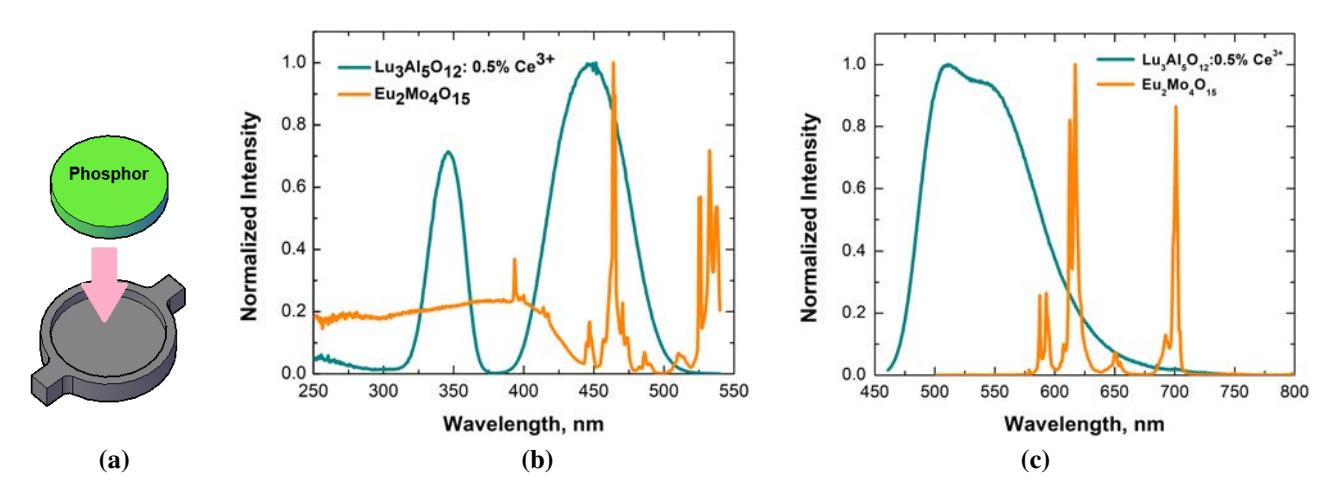
In this study, the spectral properties of two synthesized phosphors prepared by a high temperature solid state reaction [3] - Lu3Al5O12: 0.5%Ce3+ (LuAG) and Eu2Mo4O15 (EMO) - were analyzed and their applicability for optical thermometry was investigated. The samples of each phosphor were prepared by mixing 15 wt% with silicone and letting them to solidify in 2 mm deep molds as shown in Fig. 1(a).
Data collection was performed with a standard technique involving the use of integrating sphere and measurement of phosphors spectra in A, B and C configurations. The spectral properties such as Photoluminescence (PL), PL efficiency, and PL dependence on the temperature were measured. PL quantum efficiency was determined in line with the analysis described by de Mello (1997). [4] Excitation sources used for LuAG were 450 nm and 468 nm, while in EMO case, a 463 nm source was included. The results have shown that EMO is strongly dependent on the ambient temperature, whereas LuAG was found to be more stable with the changes in temperature.
During the presentation, results of temperature dependence of LuAG and EMO PL spectra as well as fluorescence intensity ration for temperature determination will be demonstrated.