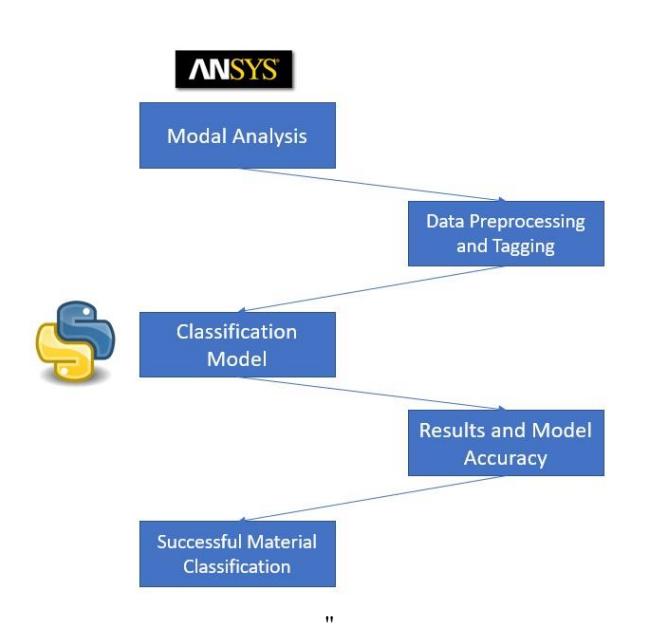
Modal analysis is a powerful tool to ensure the safety of materials and one of the non-destructive materials characterization methods, the study shows applying machine learning to have a classification scheme of materials. The concept of classification through the study is validated for isotropic and orthotropic materials reaching up to a 100% accuracy when deploying the machine learning approach with the created interrelation variables between the mode number and the associated frequency, ANSYS was used to simulated modal analysis. This study shows a new classification method depending only on the knowledge of resonance frequency only of the material.
The study demonstrates the ability to classify the engineering materials including isotropic and orthotropic materials by applying ML (Machine Learning) algorithms on the modal analysis results, the proposed ML approaches could reach an accuracy of 100% when interrelations are created between the inputs to the ML algorithms (the combined linear regression approach in this study). Keras model wasn't suitable for this study as it showed 50% accuracy when compared to the ML approaches. The study validates the classification applicability based on the resonance frequencies information only which broadens the horizons of further applications like a device that can classify the materials based on their modal analysis. Potential future studies can study other DL (Deep Learning) approaches and the deployment of neural networks that can achieve promising classification studies. Further extensions and relations can be established for detailed materials properties identification through deploying the concept of ML and DL into the field of mechanical engineering which proves the modern concept of science integration. The results of this study can boost the non-destructive materials characterizations in general and analysis methods not just the explored modal analysis example as ML and DL deal mainly with data regardless of the acquiring method.