
Phenol is widely found in effluents generated by several chemical industries and it is considered one of the priority contaminants due to its high toxicity at low concentrations. This makes it necessary to remove phenol from industrial effluents before it is discharged into the environment. The emergence of nanotechnology has enabled the design of new and promising adsorbent materials [1]. In particular, carbon nanotubes (CNTs) have proved to be a promising solution for water purification through the adsorption operation, as they have an excellent adsorption affinity for various organic pollutants [2]. However, it is difficult to remove and separate CNTs from water after the adsorption operation. In order to overcome this barrier, an interesting alternative is the development of hybrid CNTs adsorbents. The biopolymer chitosan is attracting considerable interest as a matrix for CNTs, due to the presence of hydroxyl groups (-OH) and primary amines (-NH2) that act as active adsorption sites, making it an efficient adsorbent [3]. Therefore, a sponge composed of chitosan/CNT was developed, characterized by scanning electron microscopy (SEM) and applied to phenol adsorption in aqueous solution. The kinetic behavior was evaluated using different stirring rates (50, 100 and 150 rpm). The results show that the adsorbents presented a rough and irregular surface, as shown in Fig. 1, which indicates good accessibility of phenol on the surface of the adsorbent. According to Table 1, the pseudo-second-order (PSO) was more adequate than pseudo-first-order (PFO) kinetic model to represent the adsorption phenomenon at all rotations, and the maximum adsorption capacity was 228.7 mg g-1 at 150 rpm. Therefore, this study demonstrated the development of a promising adsorbent with high adsorption capacity, low cost and interesting mechanical properties for the removal of phenol from aqueous solution.
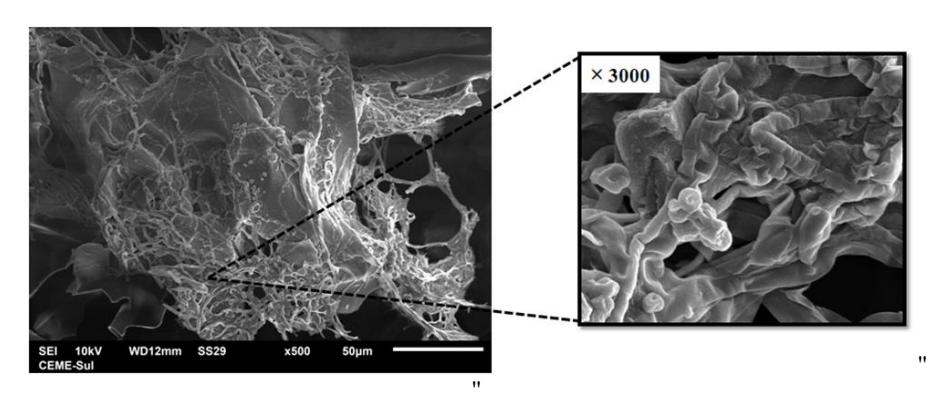
| Stirring rate (rpm) | 50 | 100 | 150 |
|---|---|---|---|
| PFO | |||
| q1 (mg g-1) | 162.8 | 196.6 | 210.6 |
| k1 (min-1) | 0.102 | 0.140 | 0.167 |
| R2 | 0.987 | 0.982 | 0.987 |
| ARE (%) | 5.5 | 5.7 | 4.1 |
| PSO | |||
| q2 (mg g-1) | 184.5 | 216.1 | 228.7 |
| k2 (g mg-1 min-1) | 0.0007 | 0.0009 | 0.0010 |
| R2 | 0.993 | 0.994 | 0.993 |
| ARE (%) | 4.7 | 2.5 | 2.6 |