The work focuses on the synthesis of zinc oxide (ZnO) nanoparticles and the study of the functional properties of these particles. ZnO has a unique combination of optical, piezoelectric, magnetic, and sensory properties (this is an important aspect in the development of various sensors). The ability of ZnO to absorb ultraviolet light (10-400 nm) is applied in the production of solar cells coatings and ultraviolet sensors [1]. By illuminating the surface of the ZnO coating with ultraviolet light, it is possible to create free vacancies of the oxygen atom, which changes the internal properties of the material, such as increasing the n-type conductivity and wetting the material. Zinc oxide is an inorganic compound found in the form of a white powder, almost insoluble in water. ZnO is a relatively soft material with a Mohs hardness of ~ 4.5 [2]. High heat capacity and conductivity and high melting point are particularly important in ceramics [3]. ZnO has a wide range of functional properties when applied in optoelectronics, spintronics, and piezoelectric transducers. ZnO is a semiconductor, from the point of view of nano- and microstructures it is a very extraordinary material with a wide band gap - $E = 3.37$ eV [4]. This material is physically very strong, its Jung's modulus reaches 150 GPa and is relatively stable up to high temperatures (1800 °C). ZnO has a relatively high nuclear binding energy (60 meV), so ZnO shows potential for ultraviolet (UV) optoelectronics applications [5]. This unique tetrapod structure consists of four hexagonal rods, also called "legs", which are connected to each other through the central core at an angle of 105° to 110° [5].
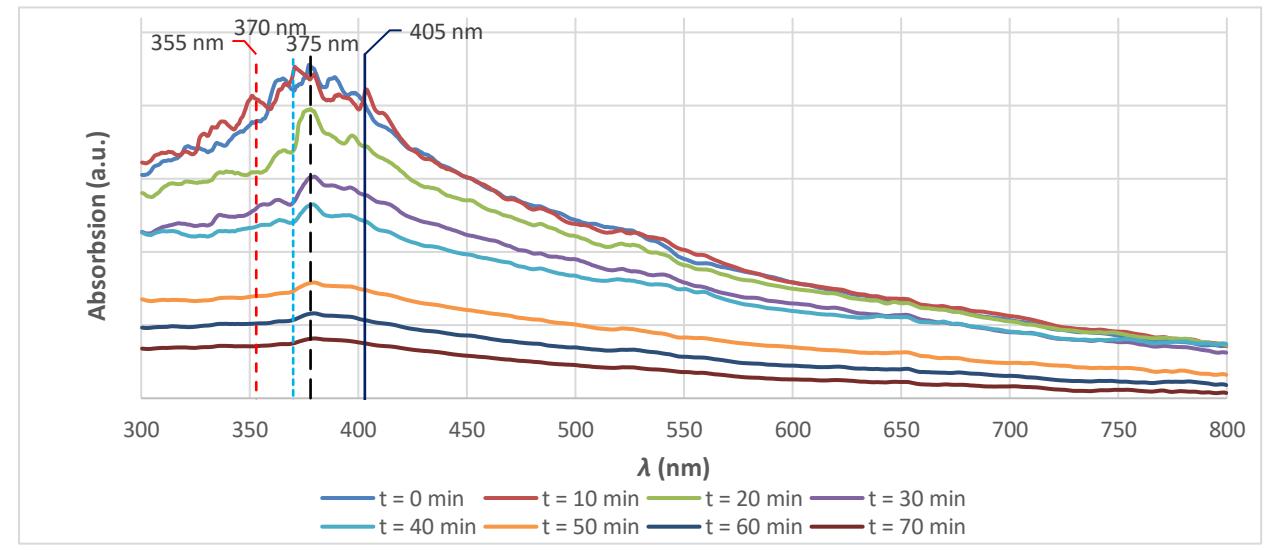
The synthesis of ZnO structures is performed by continuous synthesis (combustion) process [6]. UV-Vis spectral analysis, scanning electron microscopy (SEM) and X-ray diffraction (XRD) methods were used in this work. Based on ultraviolet - visible light spectrometry and scanning electron microscopy, zinc oxide particles of different shapes - tetrapods, nanoparticles, and various 1D and 3D nanostructures - were formed during the synthesis. UV-Vis spectrometry showed that as the colour of the flame in the burner changed from bluish to greenish, the particle size increased (58-64 nm) and the particle size decreased (63-52 nm) with increasing centrifugation speed in the range of 1000 - 10000 rpm. This shows the potential of ZnO nanoparticles for application in optoelectronic devices.