Organic solar cells (OSCs) have attracted a wide spread attention in the past decades due to their unique advantages of light weight, flexibility and solution processability, which enables low cost and a potential for large area fabrication. A major and unsolved problem with organic bulk heterojunction (BHJ) devices remains the optimization of the network morphology. In general, increasing the structural order of the BHJ is desirable as it improves charge carrier mobility and extraction.
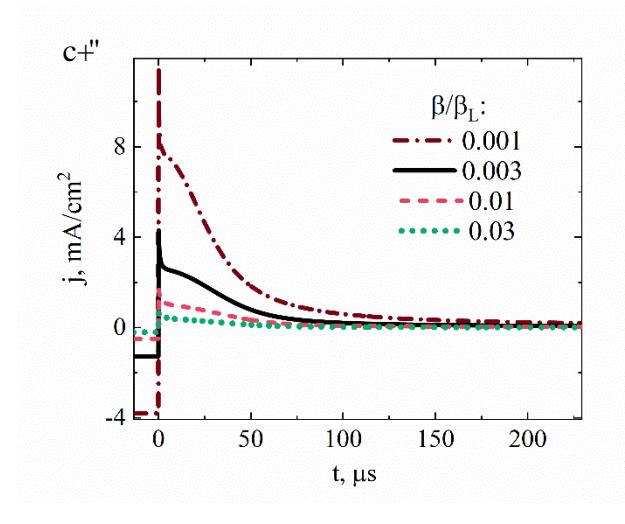
Low mobility organic materials exhibit Langevin type recombination, but in bulk-heterojunctions reduced Langevin recombination is observed [1], because of the nanomorphology of the interpenetrating network of donor and acceptor materials. Reduced recombination is strongly responsible high performance of solar cell and charge that can be extracted from the device (Fig.1(a)). Usage of proper processing solvents and additives, such as 1.8-diiodiooctane (DIO) is a known method to further enhance device efficiency [2]. Although, the most popular processing combination of chlorobenzene (CB) solvent and DIO is known to reduce overall number of ordered aggregates in the sample[3], but increasing thickness of bulk heterojunction can lead to the changes of the morphology. As such, these structures can have different morphologies, so different charge carrier mobilities and recombination rates.
One of the main methods used to determine the bimolecular recombination rate in such materials is time-of-flight (TOF)[1] technique, but it does not allow to determine how bimolecular recombination varies with carrier concentration. This drawback can be removed by using extraction of injected charge carriers by linearly increasing voltage technique (i-CELIV)[4,5], where the total recombination losses in the bulk can be determined. The goal of this work was to determine bimolecular recombination dependency on bulk heterojunction thickness with and without solvent additive DIO and to compare recombination data with that extracted from i-CELIV and establish dependency on carrier concentration.
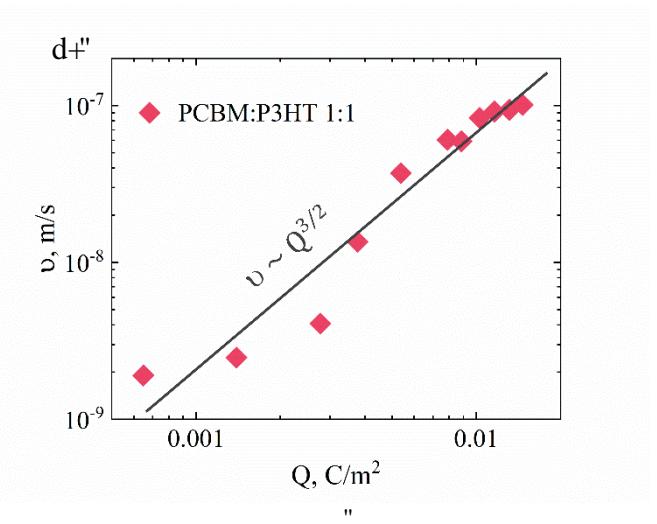
Using i-CELIV we determined that samples processed with DIO show strong carrier recombination with increasing layer thickness, while omitting the additive seems to have no effect while varying the thickness of the sample, DIO in combination with CB causes morphological changes with increasing sample thickness. It was also determined that poly(3-hexylthiophen-2,5-diyl) (P3HT) : [6,6]-phenyl-C61-butyric acid methyl ester (PCBM) 1:1 ratio bulk heterojunction has a 2D Langevin recombination mechanism as bulk recombination rate follows $v \sim n^{1/2}$ (Fig.1(b)). Additional measurements done by time-of-flight (TOF) technique shows clear link between reduced Langevin recombination and $u$ recombination rate.