In nowadays, due to cheap synthesis and simple deposition techniques organic materials are promising low cost alternatives for classical inorganic materials. In addition, organic materials can be used in the production of flexible devices. Most promising areas of application are light emitting diodes, field effect transistors, detectors and solar cells. The efficiency or (and) speed of operation of transistors, light emitting diodes, solar cells or other electronic devices is determined by the charge carriers mobility $μ$.
Usually the charge carrier mobility $μ$ in organic materials is measured by time-of-flight (TOF) technique, application of which in thin layers could be challenging. The time constant RC of the system with thin layer is usually higher than transit time of the carriers, what complicates the analysis of the current transient in the case of dispersive transport. Another problem, of application of TOF in thin films, is volume photo-generation of charge carriers, this makes hard to distinguish the sign of charge carriers.
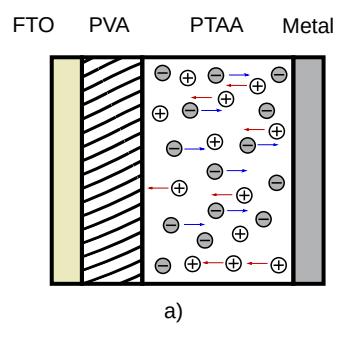
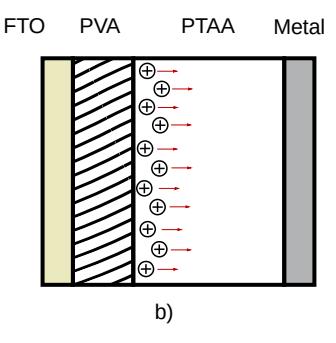
In this work we propose a modified photo-CELIV [1] (extraction of the photo-generated charge carriers by linearly increasing voltage) method for investigation of the charge carrier transport in thin organic films on dielectric layer. In order to distinguish sign of the charge carriers we apply offset voltage before photo excitation one type of carriers are pushed towards the insulator, another type is extracted from the sample (Fig. 1a). After some delay time we apply triangle voltage pulse and extract the charge carriers located near insulator interface (Fig. 1b). For the analysis of extraction currents and estimation of mobility we use same approach as in the case of injection CELIV (i-CELIV)[2].
This method allows to obtain more accurate mobility values in very thin organic layers, as well as to study a dependency of mobility on time, in the case of dispersive transport. Demonstration of the modified CELIV technique was done with the layers of PTAA polymer on the top of PVA insulator. Obtained results were compared with TOF results in thick layer of PTAA.