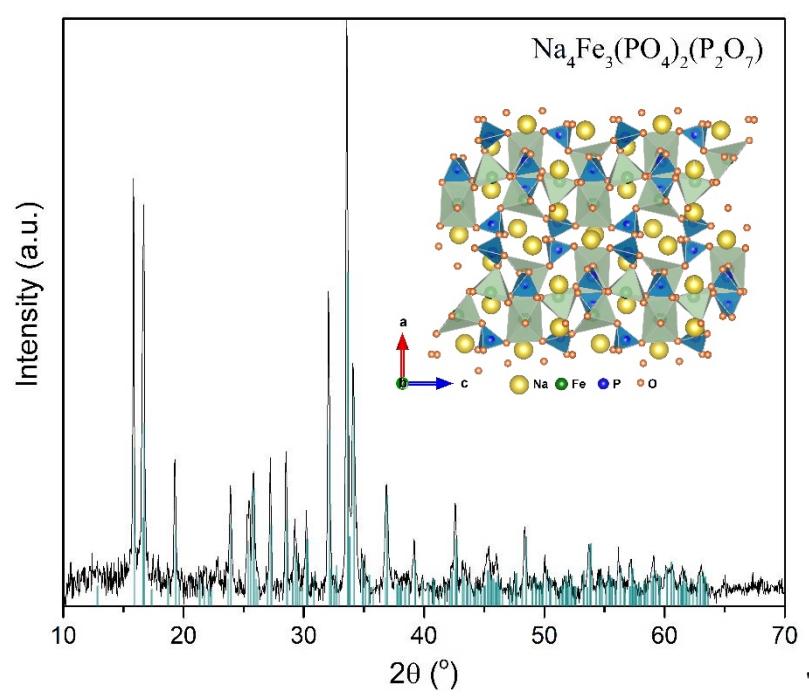
Aqueous Na-ion batteries have received particular attention of researchers as one of the main alternatives to Li-ion batteries for sustainable grid-scale energy storage. The use of aqueous electrolytes instead of organics ensures the safety, low price and environmental friendliness of such systems. Exploration and development of suitable positive and negative electrode materials are critically important for high-performance of Na-ion batteries. A great variety of polyanionic or mixed-polyanion compounds have been investigated as cathodes for such batteries. However almost all of them still face different challenges such as poor stability, low energy density or voltage [1]. Among different Fe-based phosphates (Na2FeP2O7, Na3Fe2(PO4)3 and etc.), the mixed-polyanionic Na4Fe3(PO4)2(P2O7) represents a more attractive option since it possesses the highest discharge voltage (3.1 V vs Na+/Na), favorable theoretical capacity (129 mAh g-1) and suitable 3D structure with low volume change during sodium insertion [2, 3].
In this work, we prepared pure phase Na4Fe3(PO4)2(P2O7) via solid-state and sol-gel synthesis methods using different Fe-based precursors (Fe(CH3COO)2, FeC2O4 2H2O and C4H2FeO4). The structure and morphology of prepared materials were characterized by X-ray diffraction (Fig. 1), scanning electron microscopy and thermogravimetric analysis. The electrochemical properties of prepared electrodes were investigated by cyclic voltammetry, charge/discharge galvanostatic cycling and impedance spectroscopy.