
Silicon-germanium (Si1-xGex) based devices are promising materials for operating in harsh radiation environments. Enhanced radiation tolerance silicon-germanium-based pixel detectors are capable of operating for applications in future Large Hadron Collider (LHC) [1]. Nevertheless, it is difficult to grow bulk SiGe single-crystals with intermediate Ge content due to differences in the physical properties of silicon and germanium. It has been determined that Si1-xGex single-crystals can only be obtained for containing either 0 < x < 0.1 or 0.85 < x < 1 of Ge when using the Czochralski technique. For the other x range of Ge content this alloy usually becomes a polycrystalline material. The radiation induced deep carrier traps determine the changes of semiconductor particle detector characteristics. Impurities, such as carbon or oxygen, are also important in formation of radiation-induced deep traps. It was revealed that the carbon-oxygen metastable complexes (CiOi*) were transformed into the stable-state complexes (CiOs) under 125 °C annealing for 15 min of the irradiated Si1-xGex detectors [2].
In this work, simulations of electrical characteristics of the Low Gain Avalanche Diodes (LGAD) made of both p-type silicon and silicon-germanium Si1-xGex with different Ge content materials were performed by Technology of Computer-Aided Design (TCAD) means. The functionality of the LGAD devices has been validated by digital experiments performed using TCAD algorithms and the Drift-Diffusion (DD) approach. Simulations have been carried out employing a Sentaurus Device software platform. Conventional p-type LGAD consists of N+PP-P+ layers with p-well formed by deep diffusion of boron (B) during formation of the p-layer. The parameters of traps in silicon and silicon-germanium were borrowed from literature data. The structure of both material diodes were designed using the identical dimensions, the same concentrations of dopants and the same origin of traps in order to compare the characteristics of Si and SiGe LGADs. Ge content has been varied in the range from 1% to 10%.
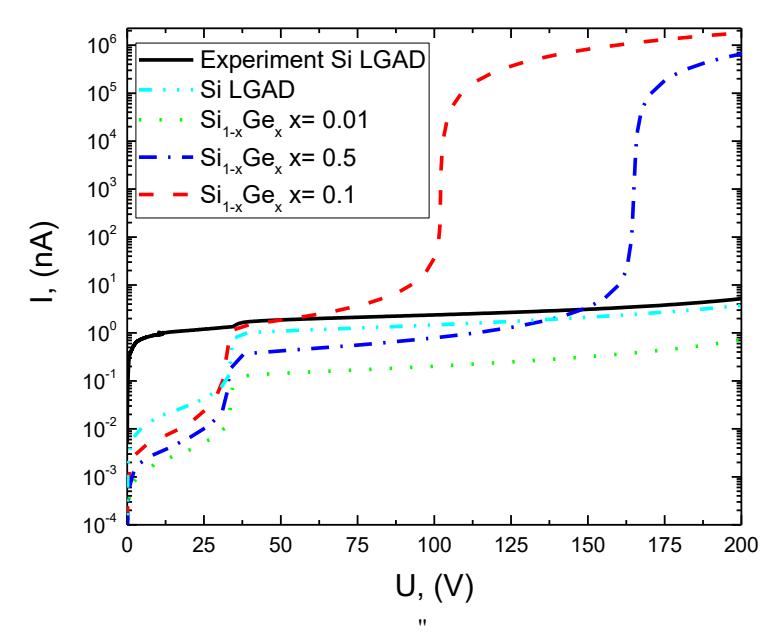
The simulations revealed the lower values of dark current in Si1-xGex LGAD structure containing 1% Ge content compared with pure Si LGAD structure. However, the higher concentrations of Ge in the SiGe LGAD structures caused the higher dark current values compared with the pure silicon LGAD. LGAD structures containing traps exhibit the higher dark current values in I-V characteristics for both Si and SiGe trap-less structures. The current pulses in Si LGAD response transients showed the elongation of the carrier extraction durations with enhancement of the trap concentration. This could be caused by carrier trapping effect due to deep emission centers.