In thermodynamic equilibrium, the crystal structures of zinc oxide (ZnO) and magnesium oxide (MgO) are hexagonal wurtzite (wz) and cubic rocksalt (rs), respectively. In a ternary compound of ZnMgO both Zn and Mg can be substituted by each other up to ~40% without losing structural stability [1]. ZnMgO solid alloy with a highly-tunable bandgap (from 3.3 eV to 7.8 eV) thus has a great potential for applications of optoelectronics in the deep-ultraviolet spectral region [2]. However, (due to rs-wz phase transformation) it is difficult to grow purely either wurtzite or rocksalt Zn1-xMgxO epilayers exhibiting the bandgap energies in the region between 4.3–5.4 eV [3]. Nevertheless, it was recently reported that the use of MgO (100) substrate provides ZnO solubility up to 85% sustaining single-phase rocksalt crystal structure. Also, MgO (100) substrate allows for a significantly smaller lattice-mismatch, enhancement of surface roughness and therefore higher optical quality, compared to conventionally used sapphire or Si substrates [4].
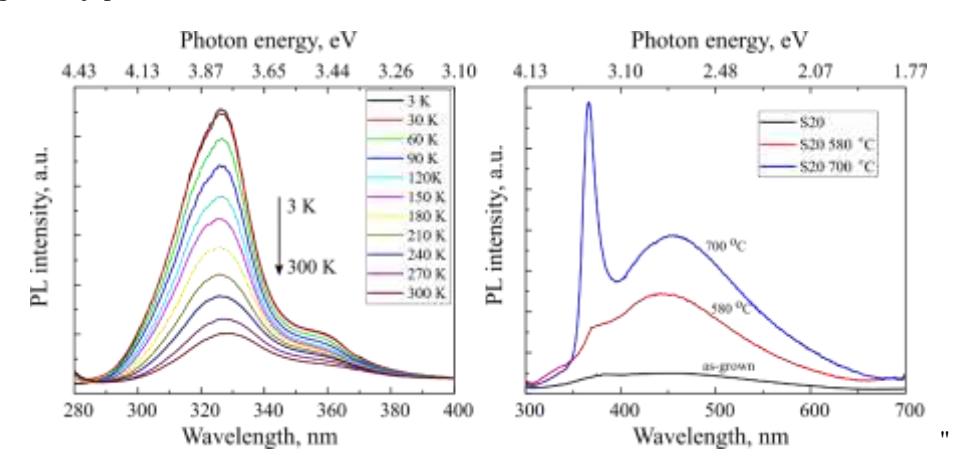
This work presents detailed temperature- and excitation- dependent photoluminescence (PL) investigation of rs-ZnMgO epilayers grown on (100) MgO substrate by plasma-assisted molecular beam epitaxy [5]. A set of samples investigated contain six rs-Zn1-xMgxO structures with different MgO content of $x = 0.15$ (sample S22), $0.2$ (S18), $0.29$ (S20), $0.52$ (S16), $0.66$ (S6) and $0.76$ (S14). PL technique was used to explore interband excitonic and defect related optical transitions in 3-300 K temperature range (see Fig. 1, a). Moreover, activation energies derived from PL measurements provided in-sight into thermal quenching of luminescence processes. Additionally, thermal annealing effect on luminescent properties of Zn0.71Mg0.29O structure (S20) were investigated. It can be observed for the S20 structure (see Fig. 1, b) that thermal annealing (performed at 580 °C and 700 °C temperatures) favors in better optical yield, owing to the reduced density of threading dislocations in these highly-strained rs-ZnMgO thin films [5].