
The Shockley-Queisser theory puts limits on conversion efficiency of a single-junction solar cell [1]. It assumes that only photons having energy close to a semiconductor forbidden energy gap are used effectively in the formation of an electrical output signal. Lower energy photons are not absorbed at all, while the residual extra energy of the higher energy photons is reckoned in only through the process of carrier thermalization.
Our investigation is initiated by our confidence that photons having energy larger than the band gap as well as photons having energy smaller than the forbidden energy gap need to be accounted through the hot carrier phenomena participating in the photoresponse formation before the lattice heating.
GaAs p-n-junction was illuminated with 25 ns-long laser pulses of $1.06 \mu m$ wavelength. Short enough pulse and the wavelength opened a way to reveal that the induced photoresponse consists of three components. The first one, $U_G$, is an electron-hole pair generation caused component resulting from the multiphoton absorption [2]. The second one, $U_{HC}$, follows the laser pulse shape and has opposite polarity, it is caused by the heating of free carriers. The third one, $U_T$, has the same polarity as $U_{HC}$ but is much slower and is caused by the heating of a p-n junction.
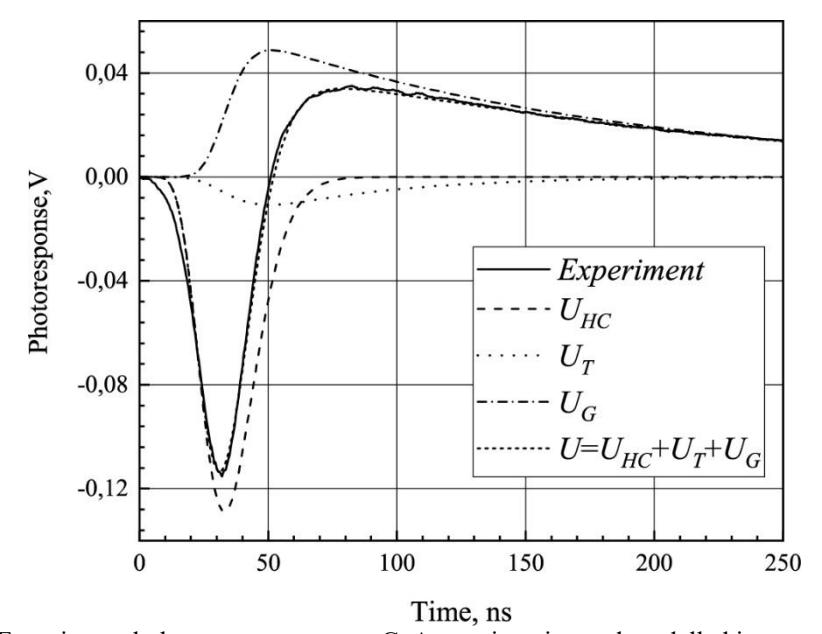
In addition to the experimental evidence of the hot carrier photoresponse, we propose a theoretical model of separation of the photoresponse components which gives good agreement with the experimental [3]. The model enables to reveal contribution of each component to the net magnitude of the photoresponse and opens the possibility to find the way of reducing the negative impact of hot carrier phenomena to the conversion efficiency of a solar cell.