
Photon upconversion (UC) through triplet-triplet annihilation is a phenomenon that finds many possible applications e.g. to increase solar cell efficiency, [1] to activate proteins inside organic tissue, [2] to enhance bio-imaging capability [3] and many others [4]. Rubrene is an excellent choice for near infrared to visible light UC, since it features low triplet energy and efficient photoluminescence (PL), which allows reaching UC quantum yield (UCQY) up to 5.6% in toluene solution [5]. However, solid-state UC rubrene systems show drastically reduced UCQY efficiency [6]. Although all the factors limiting UCQY are still unclear, the aggregation induced PL quenching and inefficient triplet exciton diffusion are the most likely ones. Reduced concentration of the annihilator may prevent quenching, however, it would also restrict exciton diffusion and hence lower the probability for triplet excitons to encounter. Therefore, the determination of diffusion length (LD) of triplet excitons and evaluation of its influence on UC performance is of crucial importance.
In this work, triplet exciton diffusion in polystyrene (PS) films containing rubrene as an annihilator, palladium phthalocyanine (PdPc) as a triplet exciton sensitizer and tetraphenyldibenzoperiflanthene (DBP) as emitter was investigated. The films were prepared by spin coating under N2 environment and encapsulated to protect films from ambient air during photophysical characterization. Triplet exciton diffusion was determined from the PL quenching efficiency in the rubrene/PS/PdPc and rubrene/PS/PdPc/DBP films with randomly distributed quenchers. Stern-Volmer analysis were applied to analyze excited state relaxation dynamics (Figure 1) of UC films with increasing quencher concentration (0.0 – 0.3 wt%) for the evaluation of LD.
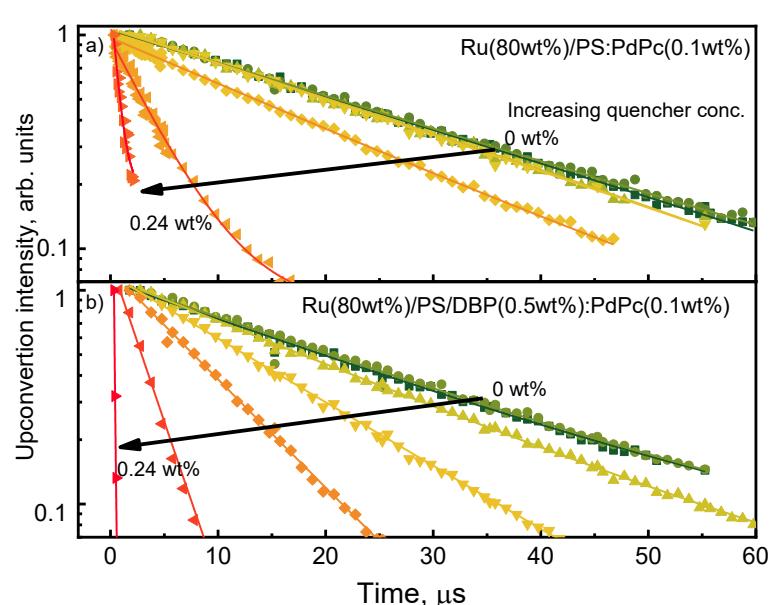
The obtained results revealed that triplet exciton diffusion length in both rubrene/PS/PdPc and rubrene/PS/PdPc/DBP films is ~22 nm. It was found that estimated LD is close to the average distance between sensitizer molecules suggesting that UC performance in rubrene UC films, to some extent, is triplet exciton diffusion limited process.