
During the last decade, the development of perovskite solar cells has flourished, as efficiencies as high as 25% were reached [1]. This indicates a potential and cheaper substitute for conventional silicon-based solar cells. However, one of the main problems preventing wide perovskite usage is their instability in ambient atmospheric conditions.
Recently a way of passivating the perovskite surface with thin layers of more stable two-dimensional perovskite was suggested. This increases the stability of the active perovskite layer and passivates surface defects but may compromise charge carrier extraction [2]. In this study, we studied the relationship between the structure of two-dimensional perovskite organic cation and charge carrier extraction through the passivating layer.
The conventional lead halide perovskite used in best performing solar cells crystallizes in cubic APbX3 structure, where A is an organic cation and X the halogen atom. While this cubic perovskite structure exhibits superior optoelectronic properties compared to two-dimensional ones, the high concentration of surface defects due to organic cation and halogen vacancies and the solubility of the organic cation in water, hinder the perovskite solar cell performance and stability. By exposing the surface of three-dimensional perovskite to certain hydrophobic organic cations thin layers of two-dimensional perovskite are formed which can both reduce the density of vacancies and increase the water-resistance of the active perovskite layer [2].
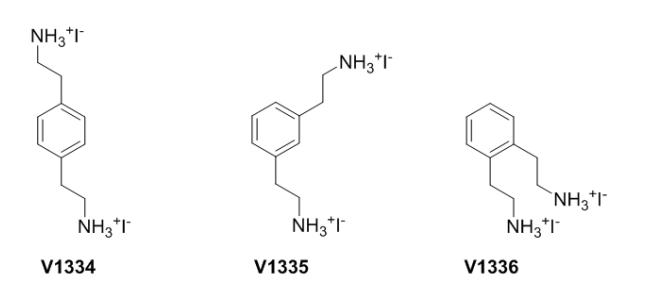
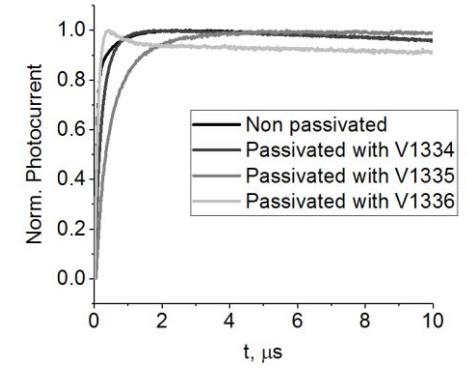
Here we present application of three isomers of a a newly synthesized (phenylene)di(ethylammonium) cation (fig. 1) towards the passivation of FA0.95Cs0.05PbI3 perovskite solar cells. After measuring the efficiencies of these devices, we found different values for each isomer. The cell which was passivated with V1335 performed significantly worse than non-passivated or passivated with V1336 which increased the efficiency. To further explore the causes of these differences we performed transient photocurrent and voltage dependent PL decay kinetic measurements. We observed that better-performing devices have faster photocurrent response and PL decay kinetics with applied external voltage than lower efficiency cells. We attribute this difference to a barrier that forms between the perovskite and hole transport layers which increases after passivation with V1335 and decreases with V1336. This suggest that perovskite passivation with o-(phenylene)diethylammonium cation allows improving hole extraction from perovskite to hole transporting material.