Optical coatings are a multilayer dielectric high and low refractive index materials thin film structures. They are widely used for dielectric mirrors, antireflective coatings, polarizers, filters etc., that are necessary components in laser system. The laser induced damage threshold of an optical coating depends on the quality of the thin film. Essential characteristics of materials involve surface and optical quality. In order to reach high optical quality, the losses of absorption and scattering should be small as possible [1]. To achieve high quality parameters of the amorphous thin films optimization of coating process parameters should be established. One of the widely used high refractive index materials for the production of optical coatings is titanium oxide TiO2 or its suboxides Ti2O5 and Ti2O7.
The research was made on titanium oxide thin films grown by atomic layer deposition (ALD) technique. Tetrakis(dimethylamino)titanium was used as precursor and ozone or oxygen plasma were used as reactants. The thin films coating processes were carried out at two different temperatures - 65 °C and 150 °C. The refractive indices, roughness and growth rates of manufactured titanium oxide monolayers were determined. Morphology, film thickness and optical properties changes after annealing at 250 °C, 500 °C and 750 °C were investigated. The surface properties of the samples were characterized using atomic force microscopy (AFM). Growth per cycle and film thickness were calculated from transmittance spectra and quartz crystal microbalance measurements. Optical properties were evaluated from the transmittance and reflectance spectra.
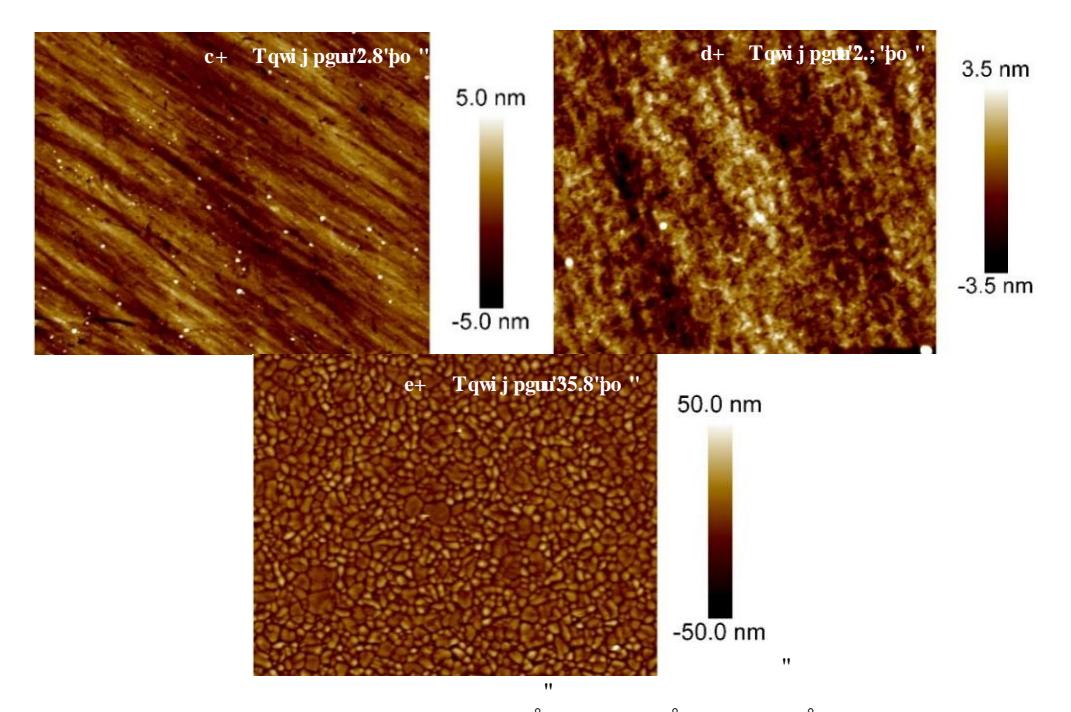
Titanium oxide monolayers morphology and optical properties depend on the process technological parameters and annealing temperature. It was found that thermal annealing at temperatures in the range of 500-750 °C enhance the formation of crystal grains and crystallites density depends on the annealing temperature. The film roughness increases to more than 10 nm only after annealing at 750 °C temperature (Fig. 1). Before the annealing all samples surface was smooth in all deposition conditions. A tendency to rise of titanium oxide thin films refractive index at higher deposition temperatures obtained in this study is similar to previously reported investigations [2, 3].