
The phenomenon of second-harmonic generation (SHG) has been widely applied to study interfaces of dielectrics. The paper focuses on analysis of signal generated from the lateral surfaces of long dielectric cylinders coated with an optically nonlinear substance and ordered in a linear structure (Fig. 1a).
As previously shown in paper [1], second-harmonic radiation is predominantly concentrated in a plane perpendicular to the cylinder axis in the case of normal incidence of a plane electromagnetic wave on the lateral surface of long cylindrical particle coated with a nonlinear layer. Therefore, generation occurs only in the Oxy plane.
Let us calculate SHG from the linear structure of long cylinders using the principle of superposition and taking into account the phase shift. The second-order nonlinear dielectric susceptibility tensor for an elementary part of a surface can be represented in the form
$$X^{(2)}_{ijk} = X^{(2)}_1 n_i n_j n_k + X^{(2)}_2 n_i \delta_{jk} + X^{(2)}_3 (n_j \delta_{ik} + n_k \delta_{ij}) + X^{(2)}_4 n_m (n_k \epsilon_{ijm} + n_j \epsilon_{ikm}), \quad i,j,k = x,y,z,\tag{1}$$where ni are the components of unit normal vector n to the surface, δij and εijk are Kronecker and Levi-Civita symbols, respectively. Let the anisotropy type X(2)i means the values of components of the tensor X(2)ijk are X(2)1 = 1, X(2)j≠i = 0.
Let us consider SHG from the structure of N cylinders with radius of their bases a ($ka = 0.1$) and distances between their axes d at normal incidence of a plane polarized wave (with the polarization plane Oxy and the direction along Ox axis) (Fig. 1a). Let us analyze the dependence of the SHG power on the distance d. Figures 1b and 1c show the dependences of the ratio of the SHG power from the structure of N cylinders (WN) to a similar value for one cylinder (W1) on the distance between cylinder axes. All curves tend to a value WN/W1 = N. An increase in distance between cylinder axes leads to decrease in variations around this level. All dependences are almost periodic; however, the distances between the peaks are non constant and vary in range $k_od \in [6.2; 6.5]$.
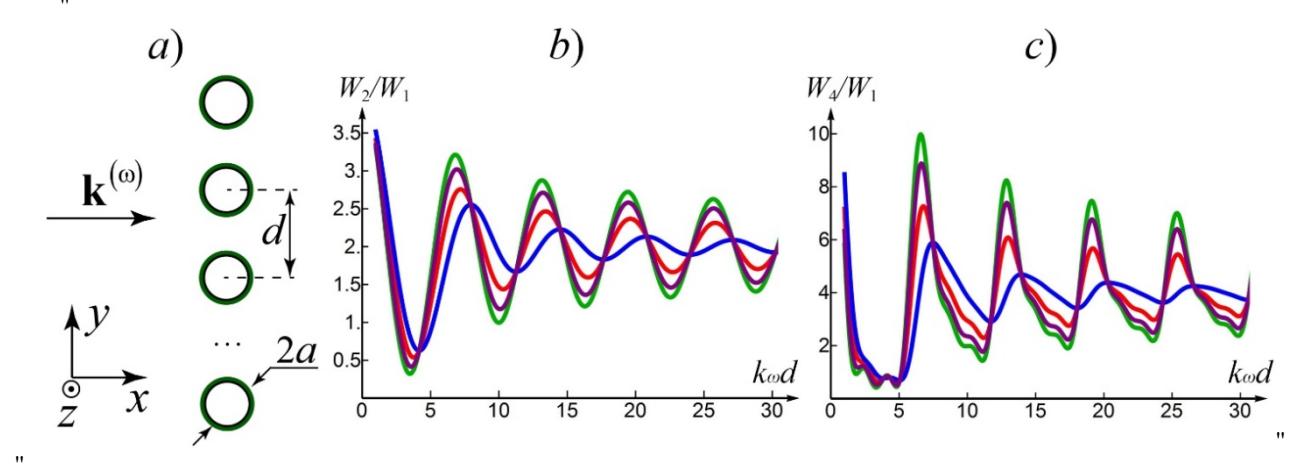
For the anisotropy types X(2)1,2,4 the curves have similar shapes with close positions of maximums and minimums. Whereas, there is a faster attenuation and entirely different position of extrema for type of the anisotropy X(2)5. At this distances between cylinder axes, the ratios WN/W1 for all anisotropy types are equal (all curves cross). As the number of particles in the structure increases, the maxima become sharper, the number of local minima increases and positions of the maxima shift to lower values of $k_od$ for the anisotropy types X(2)1,2,4.