Perturbational response theory is one of the most successfully used tools in physics, its linear version being the standard procedure to fruitfully treat complex systems. Ongoing advances in laser power combined with increasing accuracy in material design drive the need to go beyond linearity. Here we present a general formalism for the arbitrary order response functions of any observable in Fermi systems and derive a closed form for the non-interacting case. As novel technological devices for radio- and electrical signals operating outside the linear regime, e.g. as detectors, mixers, or multipliers for terahertz waves, are often based on very thin nano-structures. The two dimensional uniform electron gas (2Deg) was chosen to test our theory. We verify our expressions by confirming the results reported by Lee [1] for the quadratic order Lindhard function and newly derive the cubic density response, which can be cast into a notably lucid form.
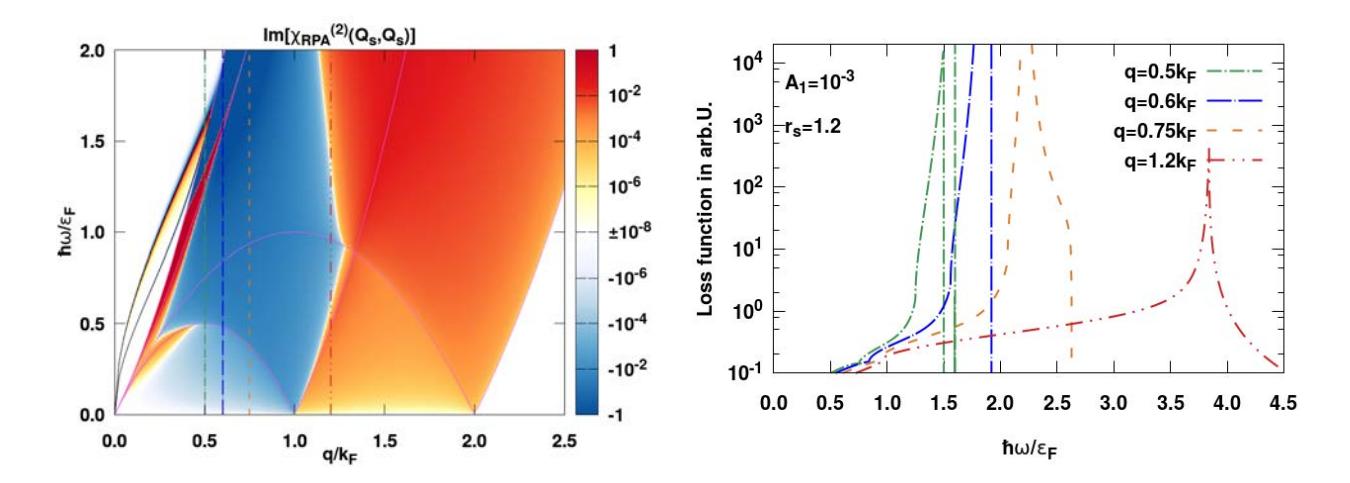
Interactions are then accounted for using the random phase approximation (RPA). This self-consistent mean field approach is quite accurate in experimentally studied 2Degs [2]. We extend the linear RPA up to third order in the perturbation aiming at an analysis of the collective modes, the sheet plasmons. In the harmonic co-linear case we further accomplished to extend the relations of Mikhailov [3] to hold for more general input signals. Compared to the linear case, a much richer particle-hole excitation spectrum gives rise to stronger Landau damping, significantly reducing the live-time of the collective modes, manifest in the electron-energy-loss-scattering function and in good agreement with the experiment of Nagao et. al [4].
So far, the spin degree of freedom was not treated explicitly. Work to investigate partially polarized systems [5] is in progress, aiming at a better understanding of the polarized electron sheets applicable in spintronics.
Fig. 1. left): 2nd order interacting response function $\chi^{(2)}_{\rm RPA}$ for a harmonic perturbation. In comparison to the first order, the second order shows two distinct and overlapping particle-hole bands (PHB), bounded with solid magenta lines. The two appearing collective modes are undamped in a wide region of wave-vectors q and enters the PHB at approx. 0.6 and $0.7k_{\rm F}$, respectively. Additional four specific cuts at $q_{\rm s}/k_{\rm F} \in \{0.5, 0.6, 0.75, 1.2\}$ are marked. right): The electron-energy-loss function within quadratic response theory for the marked wavelengths q with Wigner-Seitz radius $r_{\rm s} = 1.2$ and input field strength $A_1$. The weight and energy of the mode depends significant on q. After entering the PHB, the collective mode becomes damped quite rapidly. ($k_{\rm F}$, $\epsilon_{\rm F}$ denote the Fermi wave-vector and energy, respectively)
Acknowledgments: Mario Graml is grateful for partial support through the European Union's Horizon 2020 research and innovation program under grant agreement No. 899598 (PHEMTROMICS).
[1] C.J. Lee. Quadratic density response function of a two dimensional electron gas. Results in Physics, 5:184-195, 2015.
[2] Pavel Arturovich Gusikhin, Vyacheslav Mikhailovich Murav'ev, and Igor Vladimirovich Kukushkin. Observation of plasma waves with anomalously weak damping in a two-dimensional electron system. JETP letters, 100(10):648–651, 2015.
[3] S. A. Mikhailov. Nonlinear electromagnetic response of a uniform electron gas. Phys. Rev. Lett., 113:027405, Jul 2014.
[4] T. Nagao, T. Hildebrandt, M. Henzler, and S. Hasegawa. Dispersion and damping of a two-dimensional plasmon in a metallic surface-state band. Phys. Rev. Lett., 86:5747–5750, Jun 2001.
[5] Dominik Kreil, Raphael Hobbiger, Juergen T Drachta, and Helga M Boehm. Excitations in a spin-polarized two-dimensional electron gas. Physical Review B, 92(20):205426, 2015.