Direct laser interference patterning (DLIP) enables the fabrication of sub-micrometer periodic structures without post-processing, finding applications in photonics, electronics, medicine, and tribology [1]. To minimize thermal defects and enhance precision, fs-UV pulses are used. However, the use of broadband femtosecond UV pulses introduces spatio-temporal effects in interferometer designs, reducing fluence and degrading pattern quality.
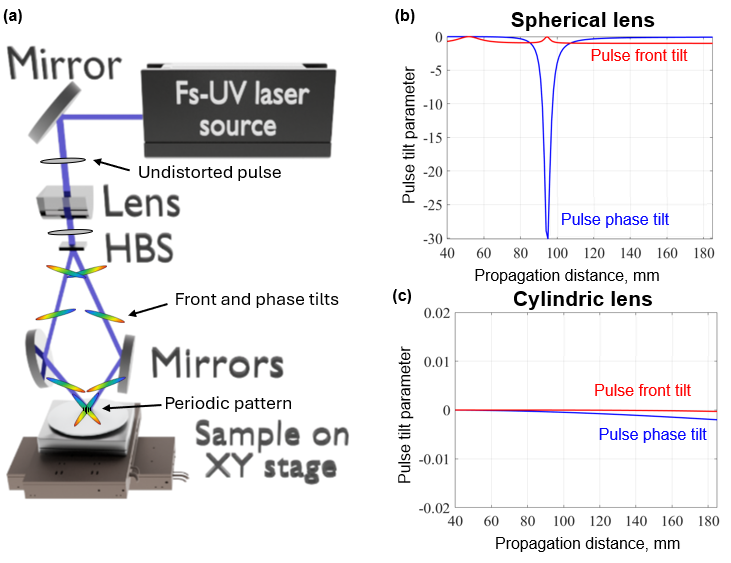
This study investigates the performance of a compact Talbot interferometer (Fig. 1a), consisting of a lens, holographic beam splitter, and two parallel mirrors, in minimizing these effects. Using the Kostenbauder matrix formalism [2,3], three lens configurations were analyzed: a spherical lens and two cylindrical lenses with perpendicular orientations. By incorporating laser and interferometer parameters, we determined which lens minimizes pulse front and phase tilt effects, which can impact pulse overlap and interference contrast.
Results show that both spherical and parallel-axis cylindrical lenses cause significant pulse front and phase tilts (Fig. 1b), leading to increased pulse duration. The latter also led to insufficient fluence, preventing patterning of (100) crystalline silicon, even at maximum laser power. In contrast, In contrast, a perpendicular-axis cylindrical lens exhibited minimal pulse distortions (Fig. 1c) and ensured optimal pulse overlap and high interference contrast and minimal pulse duration increase.
These findings demonstrate that selecting an appropriate lens configuration in Talbot interferometers is crucial for achieving high-precision DLIP.