Periodically poled (PP) crystals play a crucial role in nonlinear optics, enabling efficient quasi-phase matching (QPM). The most reliable fabrication method of PP crystals is electric field poling, where a patterned photoresist with a specified duty cycle, period and grating type (single, multi, fan-out) is applied to the crystal c-faces. A strong electric field causes domain inversion resulting in the stable periodically poled domains (gratings) and effective nonlinearity inverses its sign after each coherence length, enabling efficient nonlinear optical interactions through the highest nonlinear optical susceptibility tensor elements, efficient parametric light generation, second harmonic and THz radiation generation [1].
Poling process is prone to defects like inhomogeneity of domain period and the 50/50 duty cycle in the whole grating volume. Various methods, including second harmonic microscopy, confocal microscopy, scanning electron microscopy, near-field microscopy can visualize domain structures but are time-consuming and visualize only small parts of domain structure [2]. Therefore, there are diffraction-based methods like applying a weak electric field to the PP crystals and exposing it to laser light creates diffraction patterns which carries information about domain period, duty cycle [3]. Such method also has drawbacks which may change diffraction pattern intensities: imaging lens aberrations, CCD camera sensitivity. Multi-pass resonator-based OPO scans provide domain homogeneity data but with low resolution [4].
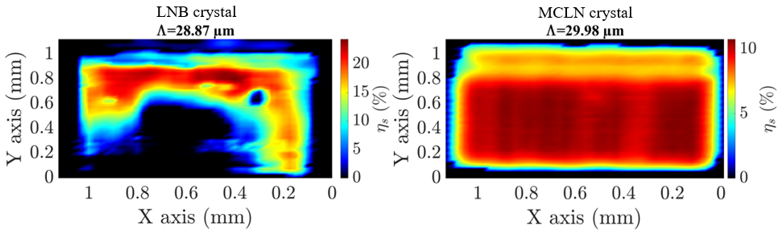
This work presents results of various PP nonlinear crystals’ poling quality evaluation using a simple and non-destructive method that was recently demonstrated in Laser Research Center [5]. The method is based on 2D scan of the PP crystal in direction perpendicular to pump beam and the measurement of parametric light generated during nonlinear process in a single pass optical OPG setup. In this way we can observe efficiency of nonlinear frequency conversion process at each crystal entrance aperture point. The result of such scan is quality homogeneity “map” which directly corresponds to domain homogeneity for all the gratings of the crystal. We constructed a universal, compact and portable optical setup, so measurements of poling quality can be performed in different laboratories with different laser sources. The scanning is performed with motorized translation stages that allow accurate scanning step (1.25µm) and the errors due to crystal physical shape are minimal as the beam passes through the crystal only a single time. The generated parametric light (signal wave) is measured with pyroelectric power sensor, so measurement is relatively fast. The quality of various condition and manufacturer crystals was estimated and compared.