
Fluorescence (FL) concentration quenching (CQ) is a phenomenon that occurs when the FL quantum yield decreases with increasing molecular concentration [1, 2]. It is observed for different systems ranging from synthetic dyes to chlorophylls in both solutions and thin films. In spite of the fact that CQ is a well-known phenomenon, its origin is not completely understood. Most frequently, it is attributed to excitation migration processes from fluorescent species to non-fluorescent ones, whose number increases with increasing concentration.
CQ results in loss of energy and is harmful for photovoltaic applications, but can be useful for biosensing applications. Therefore, it is important to i) understand and ii) control the phenomenon. One of the most effective tools for analyzing CQ is time-resolved fluorescence, which provides information on possible excitation transfer processes [1].
In this work we provide deep analysis of CQ in trans-stilbene (TS) thin films [2] and free-base and zinc phthalocyanines ([Zn]TTBPc) solutions and thin films. CQ in Pcs occurs due to Förster resonant energy transfer between monomeric species (which act as donors) and non-fluorescent aggregates (acceptor species), whose number increases with increasing concentration. To describe CQ dynamics in Pcs we apply stretched-exponential fit of FL time decay and simple model, where donor is surrounded by infinite number of acceptors (see ‘stretched’ and ‘DAC’ fits on Fig. 1 a, b). CQ in TS occurs due to smooth transition of optical properties from monomeric to crystallite with concentration increase. We apply global analysis of FL decay via non-negative matrix factorization (see Fig. 1 c) to show, that small aggregates of TS, which are formed in thin films at high concentrations, have faster (260 ps) FL lifetime compared to those of monomers (710 ps) and monocrystals (1.6 ns). 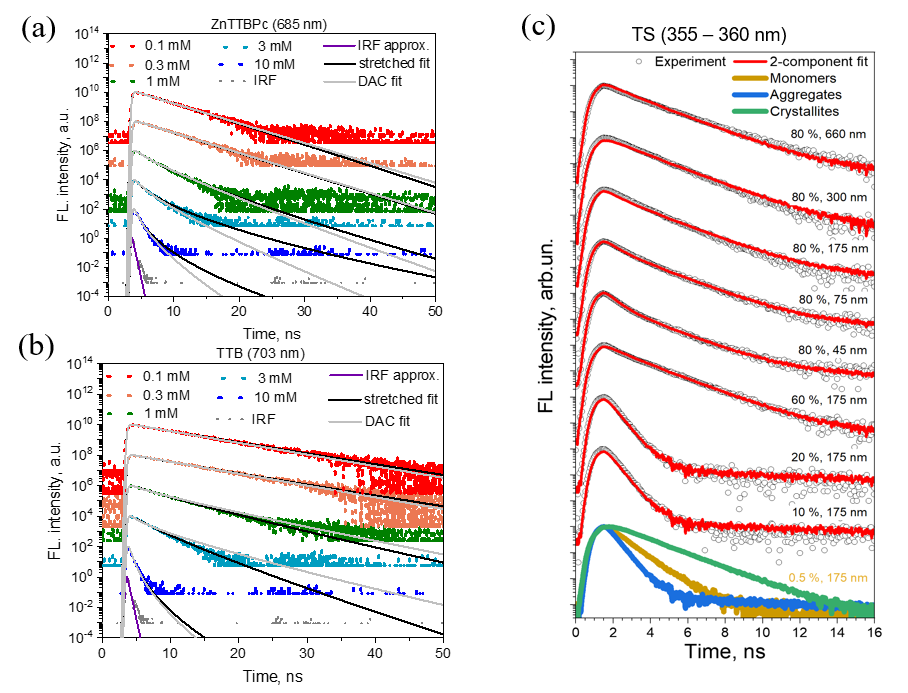
We support our analysis with steady-state absorption and fluorescence. These techniques applied together is an effective tool to analyze CQ dynamics.