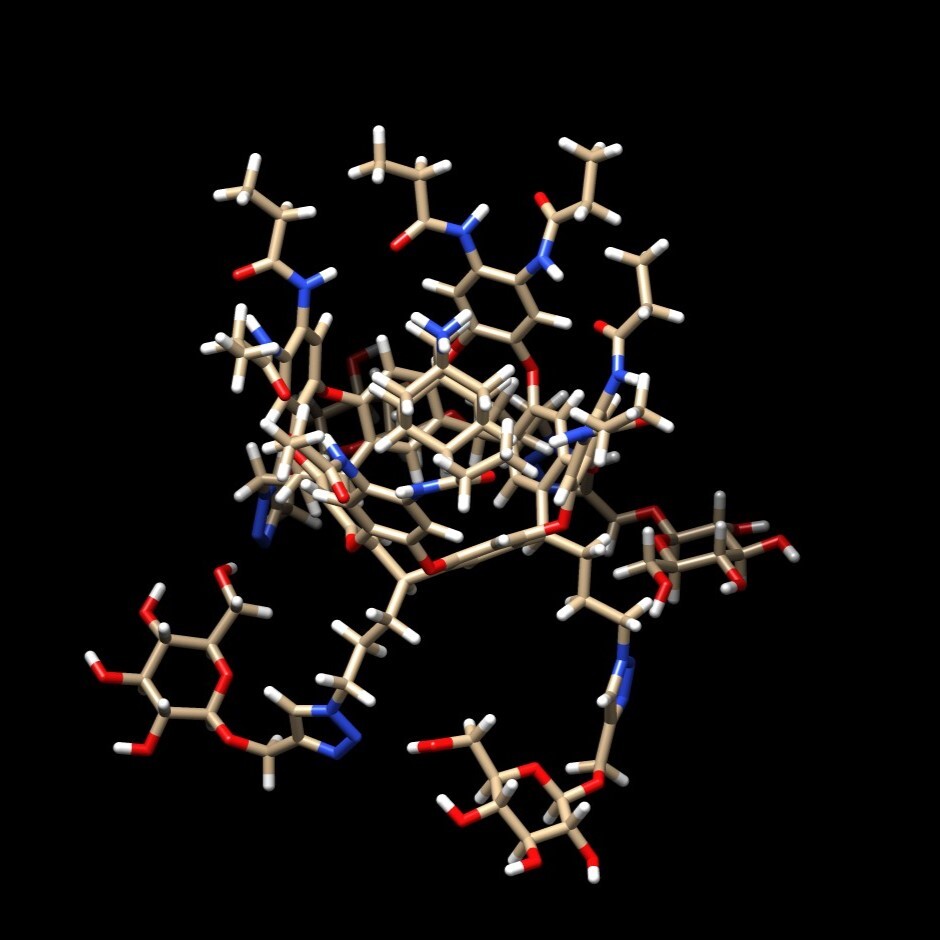
Cavitands (or synthetic receptors) are supramolecular compounds with an enclosed cavity capable of binding small molecules—an attribute that makes them promising for diagnostic applications in biological fluids. Experiments reveal that carbohydrate-based cavitands selectively encapsulate certain alkylammonium compounds, such as drug amantadine, shifting its 1H NMR signals into the negative region (relative to tetramethylsilane) [1]. This distinct spectral shift highlights the potential of cavitands for metabolomic analyses.
In this project, the tetrakis-β-D-glucosyl cavitand–protonated amantadine complex is investigated using classical molecular dynamics (MD) simulations, combined with hybrid quantum mechanics/molecular mechanics (QM/MM) methods. Classical MD allows exploration of large-scale molecular behavior under defined thermodynamic conditions, while QM/MM calculations accurately capture electronic effects crucial for NMR shielding. By averaging over configurations from the MD trajectory, temperature-dependent influences are also included. Moreover, the computed NMR spectrum shows good agreement with experimental data, confirming the reliability of this modeling approach. This integrated approach advances our understanding of cavitand–drug interactions and underpins future applications of synthetic cavitands in biomedical diagnostics. This study was supported by the Research Council of Lithuania. Computations were performed on resources provided by the High-Performance Computing Center “HPC Saulėtekis” at Vilnius University, Lithuania.
[1] D. A. Ryan & J. Rebek, "1H NMR detection of small molecules in human urine with a deep cavitand synthetic receptor", Analyst,138, 1008-1010 (2013)