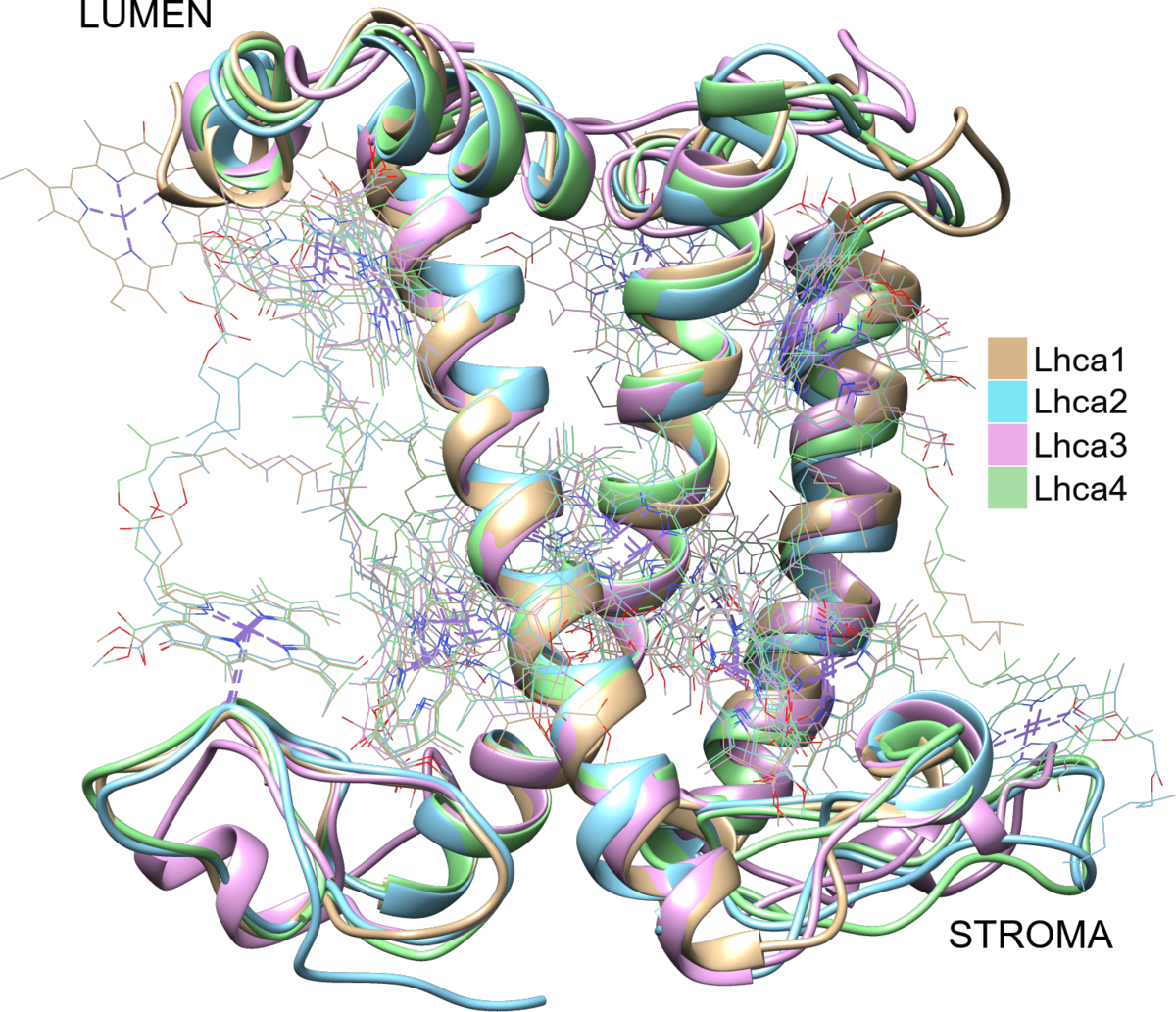
Photosynthesis is one of the most important processes on Earth. The most efficient organisms that carry out photosynthesis are land plants or higher plants. In the thylakoid membrane of chloroplasts there are two systems that carry out photosynthesis – Photosystem I (PSI) and Photosystem II (PSII), both with their own light harvesting complexes – LHCI and LHCII. PSI is the most efficient light-to-energy conversion apparatus where almost all light, absorbed by the light harvesting antenna LHCI, is converted to chemical energy [1] through the series of reactions and energy transactions. In plants, light harvesting antenna of PSI is composed of four species of LHCI complexes. They all have very similar structure; however, their spectral properties are different. The excitation dynamics in LHCI is highly affected by the charge-transfer (CT) states that occur between the pigments(chlorophylls and/or carotenoids). Known charge-transfer sites in LHCI do not completely explain the spectral properties of this antenna suggesting the presence of more CT states. The energy of these states is of course affected by the surrounding environment (pigments and the protein). Therefore, it is necessary to account for the environment to model light-harvesting complexes properly. In our work, we investigated the LHCI of PSI complex structure [2] (Fig. 1), freely available at Protein Data Bank (PDB ID: 5L8R). Properties of the excited states of the pigments were calculated using “VU HPC” Saulėtekis supercomputer. Charge-density coupling method [3] was used to evaluate excited state energy shifts, caused by the electrostatic environment. The results obtained while working with 5L8R structure were compared to the results of our previous study [4], where the object of the research was Lhca4 sub-complex structure in lower resolution. Our most recent findings demonstrate the sensitivity of pigment excited state properties to changes in the surrounding environmental geometry. Besides the geometry, amino acids can change their protonation state as well affecting the charge distribution within the protein chain and the contribution of each part to the shift of the pigment energies.