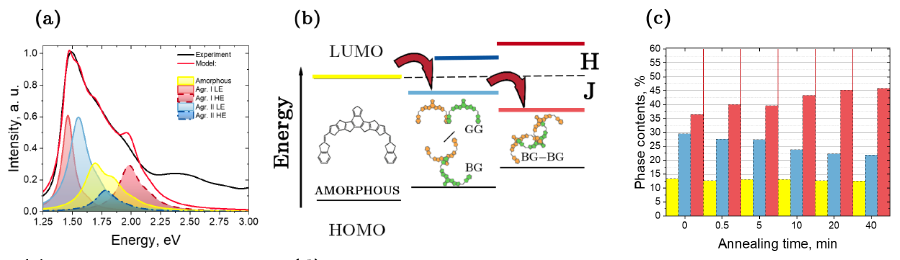
Recent advances in organic solar cells (OSCs) have been driven by the development of novel material systems, with PM6:Y6 blends emerging as promising candidates due to their power conversion efficiencies (PCEs) approaching 20%[1]. Although these efficiencies are impressive, certified OSC devices have recently surpassed this benchmark[2]. A major challenge limiting further performance improvements in PM6:Y6 systems is the incomplete understanding of the mechanisms underlying free charge carrier generation. One hypothesis suggests that free charge carriers are generated via energy cascades within the acceptor phase, where delocalized electrons migrate toward well-ordered aggregated domains, ultimately facilitating efficient charge separation[3]. This cascade mechanism may reduce recombination losses and enhance overall device performance.
In this study, we examine the role of acceptor aggregation in modulating exciton dissociation and charge separation in PM6:Y6 devices by employing spectral decomposition of the acceptor absorption spectra using Franck-Condon component analysis. Inspired by recent work from the Danie Khoh group[4], our method deconvolutes the complex absorption spectra of Y6 into distinct vibrational components, thereby distinguishing between aggregated and non-aggregated states. We observe that specific Franck–Condon vibrational progressions correlate with different molecular arrangements: well-ordered, aggregated Y6 domains exhibit red-shifted spectral features, whereas disordered regions display blue-shifted signatures.
By systematically varying the blend stoichiometry and thermal annealing conditions, we correlate the degree of Y6 aggregation with changes in the optical absorption profile and subsequent photocurrent generation. Our results indicate that a moderate degree of aggregation promotes exciton delocalization and enhances free charge carrier generation, thus facilitating more efficient charge separation at the donor-acceptor interface. In contrast, both excessive and insufficient aggregation lead to the formation of quasi-stable delocalized states or increased non-radiative recombination losses. Furthermore, time-resolved fluorescence measurements support the conclusion that aggregate formation modulates the local electronic environment, influencing the energy offset between excitonic and charge-transfer states.