
Periodic structures, featuring periodic modulation of optical constants, exhibit polarization control, spectral and angular selectivity of light, and thus were found extremely useful for laser radiation manipulation. However, fabrication technologies of periodic structures have to face strict requirements for laser optics, especially for high-power systems. Despite a sub-micrometer scale of periodicity required for visible and infrared spectral region applications, the next significant criteria are optical transparency and durability, which require a completely inorganic composition of all constituent materials. Polymers are quite easily processed and can be transparent in the target spectral regions, but they exhibit lower optical resistance compared with fully inorganic materials such as metal oxides [1]. Although direct patterning the latter while striving for sufficiently low surface roughness is a non-trivial task, especially if sub-micrometric periodicity is required. To get around a direct patterning of metal oxides, a metallic thin film deposited on a glass can be structured. Subsequent annealing at elevated temperatures promotes a metal oxidation reaction, resulting in a fully inorganic, transparent periodic structure. Several structuring techniques capable of submicron surface patterning have been described in the literature, including lithography, ion beam etching and ultrashort laser processing. Among these, only the latter can circumvent the complexities associated with other techniques, such as contamination during manufacturing, time-consuming and expensive large-scale production. Based on this, ultrashort laser processing, specifically Direct Laser Interference Patterning (DLIP), was chosen for this study. 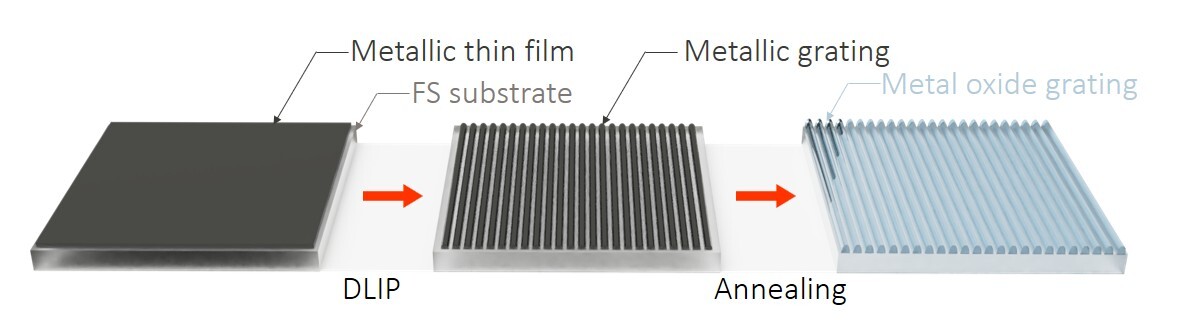
SUBMICRON PERIODIC STRUCTURES IN METAL OXIDE THINFILM VIA LASER ABLATION AND THERMAL OXIDATION
Julianija Nikitina1, Simonas Indrišiūnas1, Tomas Tolenis2, Mindaugas Andrulevičius3, Lina Grinevičiūtė1
1 Department of Laser Technologies, Center for Physical Sciences and Technology, Vilnius, Lithuania
2 ELI Beamlines Facility, Extreme Light Infrastructure ERIC, Dolní Bŕežany, Czech Republic
3 Institute of Materials Science, Kaunas University of Technology, Kaunas, Lithuania
[1] A. Žukauskas, et al., ‘Effect of the photoinitiator presence and exposure conditions on laser-induced damage threshold of ORMOSIL (SZ2080)’, Optical Materials, vol. 39, 2015, doi: 10.1016/J.OPTMAT.2014.11.031.
[2] J. Nikitina, et al., ‘Submicron periodic structures in metal oxide coating via laser ablation and thermal oxidation’, Applied Surface Science Advances, vol. 24, December, 2024, doi: 10.1016/j.apsadv.2024.100660.