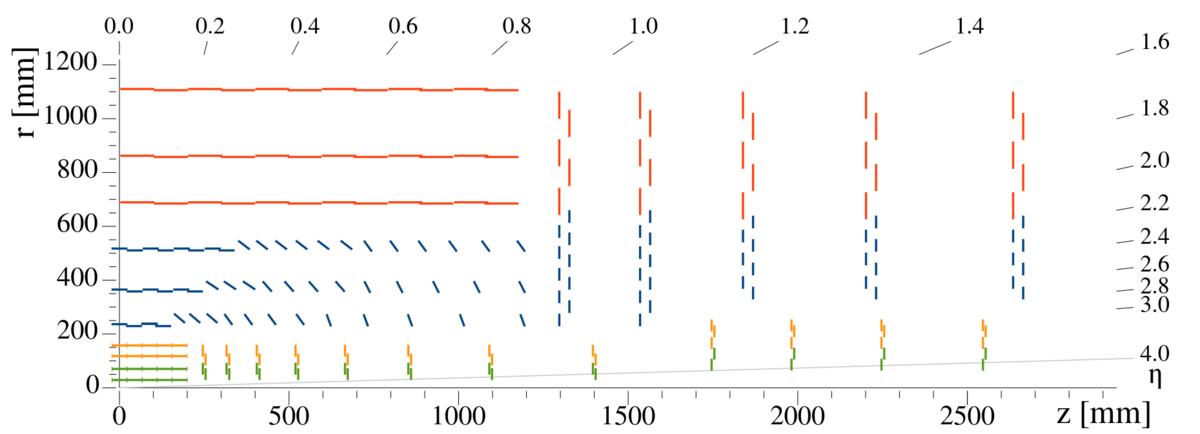
The Large Hadron Collider (LHC), located at CERN, is currently the world’s largest and most powerful particle accelerator, with the circumference of its ring tunnel being approximately 27 kilometers [1]. Two beams of particles, sped up to achieve up to the record energy of 6.8 TeV per beam [2], travel inside the LHC, regularly colliding at four designated particle collision points. Particle detectors are stationed at each collision point, with Compact Muon Solenoid (CMS) – a general purpose detector – being one of them [1].
After Run 3 ends in July 2026, LHC will go into Long Shutdown 3 during which it will be significantly upgraded. This project is called the High-Luminosity Large Hadron Collider (HL-LHC) and is scheduled to be finished by 2030 [3]. After the upgrade, it is planned that the LHC will run at a center-of-mass energy of 14 TeV and its instantaneous peak luminosity will increase roughly by a factor of 5 to 7.5 compared to its current nominal luminosity [1, 4]. This means that there will be a lot more particle collisions, which will significantly increase the potential of observing interesting physics phenomena. However, the levels of radiation will also rise, necessitating robustness upgrades to both the collider and the detectors.
Together with the LHC, CMS will also be upgraded to maximise the efficiency of the luminosity increase. This is the CMS Phase-2 Upgrade project, which will notably improve on the detector granularity, the trigger system and the detector’s resistance to decay from radiation. To help reach these goals, the silicon tracking system, which is the closest to the collision point and receives the most radiation, will have to be fully replaced. The system itself will be composed of the Inner Tracker, based on silicon pixel modules, and the Outer Tracker, consisting of silicon strip and macro-pixel modules [4].
The pixel module is the building block of the Inner Tracker. Its main components are the sensors, bump-bonded to the readout chips, which are wire-bonded to the module readout. It is planned that the Inner Tracker will consist of modules with two or four readout chips, as shown in Fig. 1 [4].
The current iteration of pixel chips, called the CROCv2, is entering the production phase and has to be tested to guarantee the compliance to the high integrity standards. This testing chain has to calibrate the module and test for dead pixels, noise levels, readout latency and other parameters. In this presentation, we will present our performed testing procedures and the results observed with the current production modules.