
The research is mainly focused on determining the properties of electrospun polymer fibers with encapsulated magnetic particles in a rotating magnetic field.
To do this superparamagnetic particles were obtained chemically by coprecipitation method. A solution was prepared by dissolving polyacrylonitrile fibers in dimethylformamide and adding magnetic nanoparticles. The solution was then pumped through a needle into a spinning camera with a voltage applied between the solution in the needle and the walls of the camera, and then dried. The result was electrospun fibers containing magnetic particles.
The fibers are immersed in a fluid and are then subjected to an ultrasound treatment to obtain finer strands of the fibers. The resulting sample was placed in a rotating magnetic field under a microsope for further investigation.
The microscope is connected to a camera with an overhead view of the solution of particles and fluid. The sample is placed into a magnetic coil system where a three-dimensional time dependant magnetic field can be generated which surrounds the sample when it is under the microscope. The behavior of these magnetic particles under the influence of a rotating magnetic field is then filmed at different magnetic field rotation frequencies and strengths. The smallest magnetic field rotation frequency at which a particle in the fluid can no longer follow the magnetic field is the critical frequency. For frequencies above critical the particles show back and forth rotation without completing a full rotation. The critical frequency can be obtained by the angle the particle lags behind the magnetic field for frequencies below critical and by the mean rotation of the particle for frequencies above critical. The critical frequency allows us to relate the magnetic and hydrodynamic properties of each particle. The critical frequency is obtained in the fluid to obtain the magnetic properties of the material. When the magnetic properties are obtained, the particles are used as magnetic probes to obtain viscoelastic properties of the fluid.
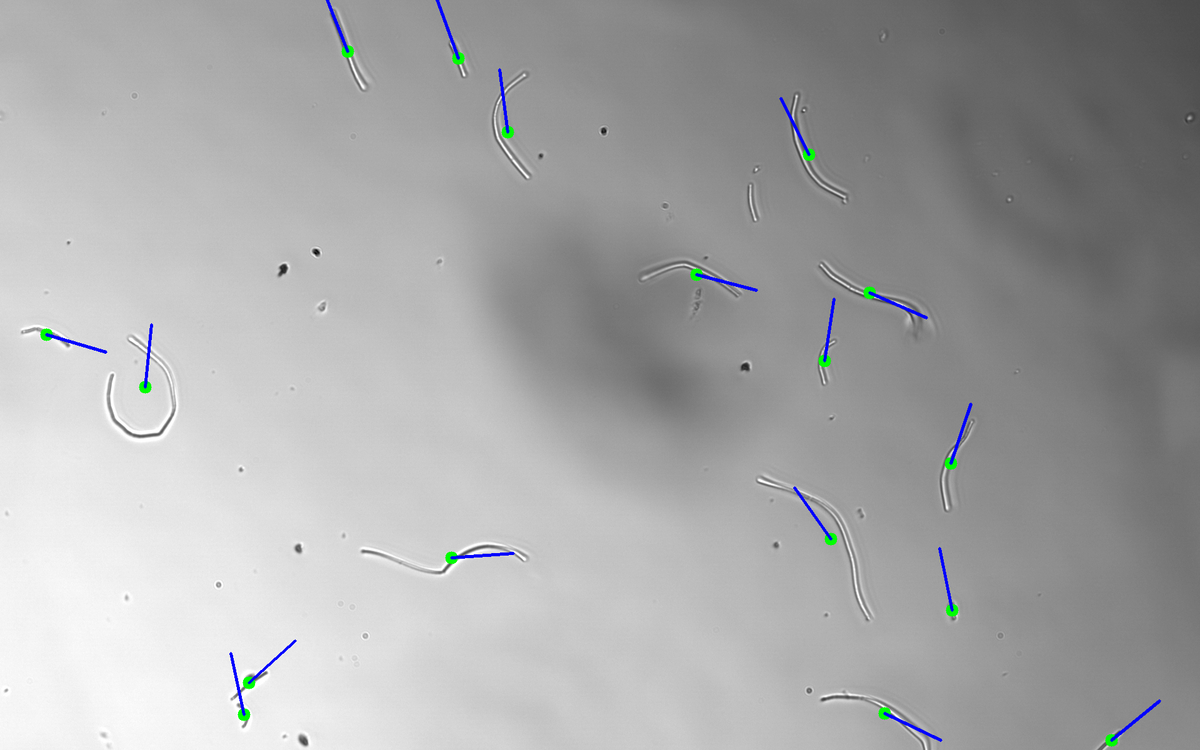
The data from the filmed videos of the particles is obtained using an image processing algorithm which is written in Python code. It detects the center of mass coordinates, orientation, surface area and length of the particles within each frame of the video. The center of mass of the particle is determined using moments obtained by an OpenCV function. The orientations of particles are determined by using moments and creating a covariation matrix for each particle and determining the eigenvector of this matrix corresponding to the major axis. This vector does not change orientation with respect to the particle as long as it does not change its shape. And the length of a particle along its trajectory is determined using skeletonization of particles in the image.