
Interferometry is ubiquitous in dimensional measurement as it constitutes an extremely sensitive and highly versatile metrological tool. Depending on the configuration, it can be used for the characterization of surface topologies, distances or vibrations. Many of these applications require spatially resolved measurements. This can either be achieved by classical imaging of the object to the detector using an objective lens or by a lensless (or non-imaging) holographic setup. Accordingly, either an image of the object plane or its farfield distribution is superimposed with the reference beam and thereby characterized. Both methods can also be implemented in off-axis-configuration, which sacrifices some spatial resolution to enable single-shot measurements instead of the sequential phase shifting required for an inline-configuration. Apart from the required post-processing, imaging and lensless methods thus offer identical performance in theory. In practice however, depending on the properties of the measurement object, one method may lead to a more efficient use of the detector than the other. Fig. 1 illustrates this idea by an example. 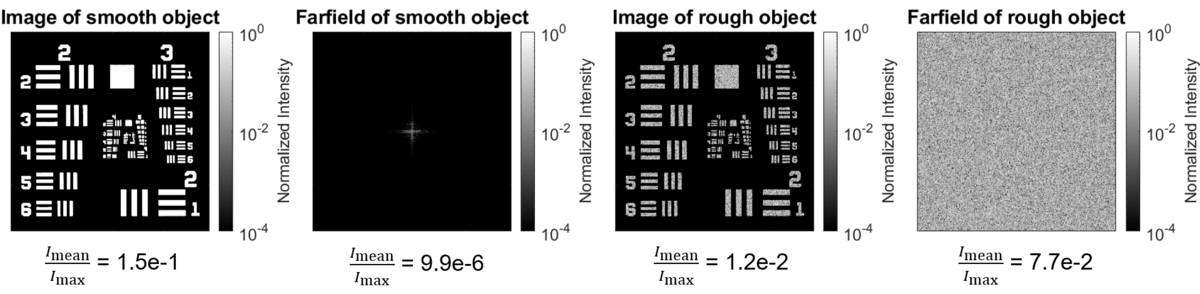
THEORETICAL ANALOGIES AND PRACTICAL DIFFERENCES BETWEEN IMAGING AND LENSLESS INTERFEROMETRIC METHODS
Florian Dötzer1, Marie Mannagottera1, Stefan Sinzinger1
1 Optical Engineering Group, Department of Mechanical Engineering, TU Ilmenau, Germany
Fig. 1. Simulated intensity distributions (normalized to the respective maximum value) for images and farfield distributions of a plane wave, reflected/scattered from an optically smooth/rough USAF target.