Electron paramagnetic resonance (EPR) spectroscopy is a widely used technique for studying paramagnetic centres in materials ranging from solids to proteins. The method is based on the quantum nature of the electron spin, which causes splitting of its energy levels in the magnetic field. The essence of EPR spectroscopy is the excitation of the quantum transitions between these levels and the detection of the microwave absorption using microwave resonators [1,2].
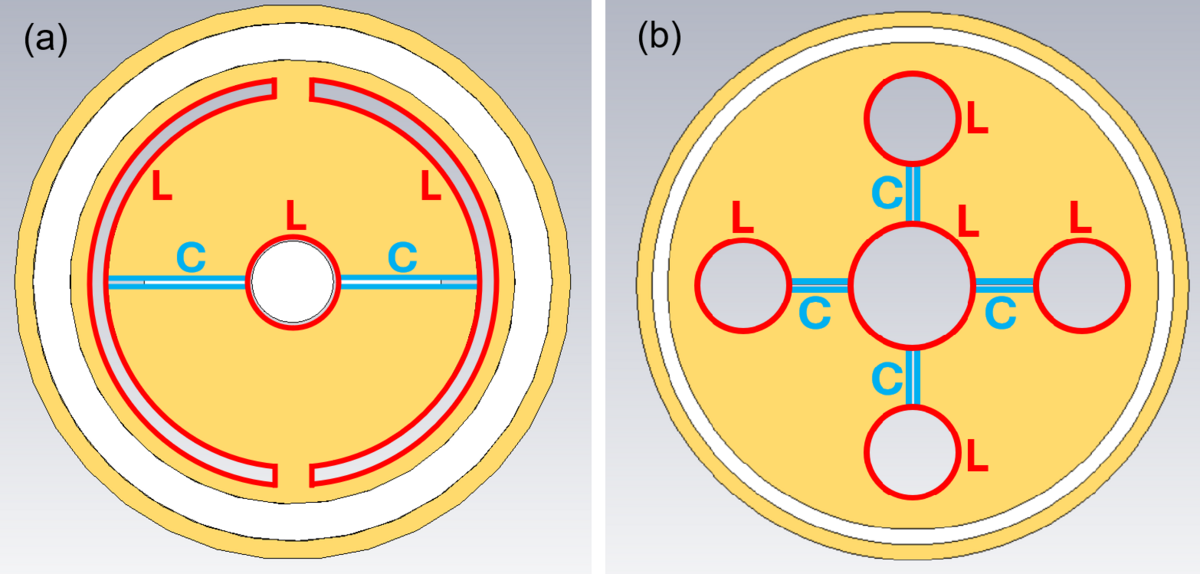
Here, we use CST Microwave Studio computational electromagnetics tool to simulate microwave coupling of a 3.1 GHz microwave resonator for EPR studies of spin qubits in \(^{171}\)Yb:CaWO\(_4\). Two loop-gap microresonator designs and various ways of microwave coupling were investigated (Fig. 1). We also explore how the microwave magnetic field homogeneity in the central loop of the microresonator depends on the number of outer loops. We compare our simulation results with the experimental observations and further discuss the best microwave coupling geometries.