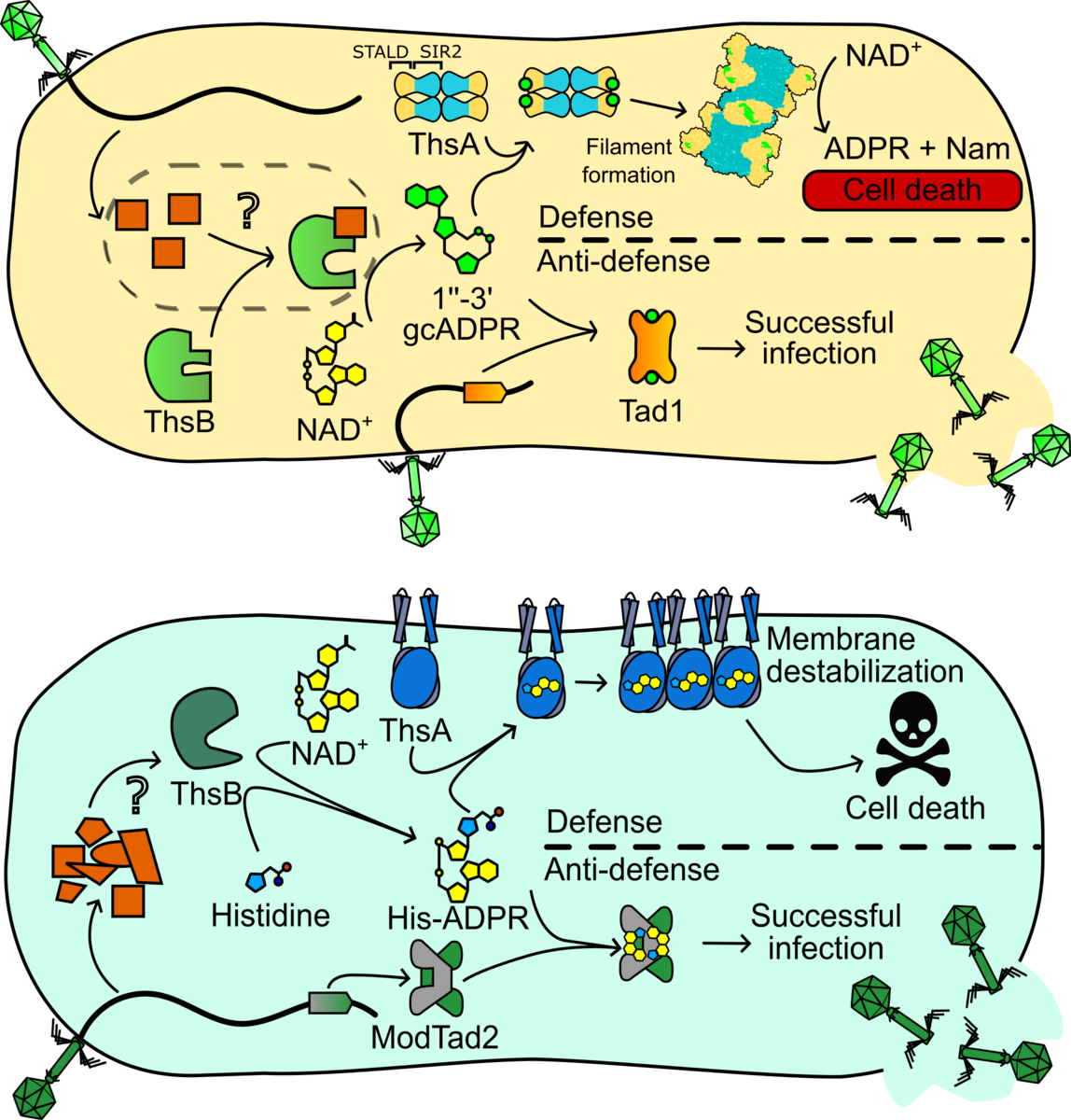
$ BASED INTRACELLULAR SIGNALS} In nature, bacteria are in constant danger posed by viruses that infect them, named bacteriophages (phages). This caused bacteria to evolve genetic elements called defense systems, to protect them against phage predation. In addition to the well-known gene and genome “scissors” - restriction-modification and CRISPR-Cas systems - more than 100 different bacterial antiviral defense systems have recently been discovered[1]. Many of these systems are based on two module composition: a sensor which recognizes phage infection and an effector which halts the phage cycle, commonly by exerting a toxic effect to the bacterial cell. Thoeris is a two module bacterial defense system consisting of a sensor ThsB homologous to the TIR (Toll/interleukin-1 receptor)-domain and an effector, ThsA protein[2]. ThsB recognizes a phage infection and synthesizes a unique signaling molecule which is then bound by the ThsA effector, exerting a toxic effect[3]. Based on the domain composition of ThsA proteins Thoeris systems are classified into types: type I (SIR2-STALD)[4] and type II (TM-Macro)[5].
Structural (cryo-EM, x-ray crystallography) and functional (enzyme assays, spectroscopy, biological assays) techniques were used to decipher the mechanism of action of Thoeris type I and type II systems. It was shown that type I ThsB’ uses NAD\(^+\) as a substrate to produce 1’’-3’-gcADPR signaling molecule, which is then bound by STALD domain of type I ThsA protein. This causes conformational changes in ThsA protein and subsequent oligomerization into filaments. This action activates ThsA NADase activity via SIR2 domain, which depletes cellular NAD\(^+\) and halts the phage cycle.
For type II system it was shown that ThsB uses amino acid histidine and NAD\(^+\) as substrates to produce a signaling molecule His-ADPR. This signaling molecule is then bound by the Macro domain of type II ThsA protein and causes its oligomerization. This points to a possible membrane disruption mechanism via its transmembrane domains to halt the phage cycle.