Femtosecond laser induced selective etching (FLISE) is a subtractive microfabrication technique which allows for the formation of 3D structures in transparent materials with resolution as small as a few microns. The maximum height (depth) of structures which can be fabricated is limited by the choice of focusing optics. By using low numerical aperture (NA) objectives structures with heights of over a centimeter can be written.
For structures written using a low NA objective we investigate how different writing parameters affect etching selectivity and quality. Our goal is to find parameters that give a high etching rate while keeping good etching quality. Modification shapes are examined as well since it has previously been shown that low NA objectives can produce circularly shaped modifications [1].
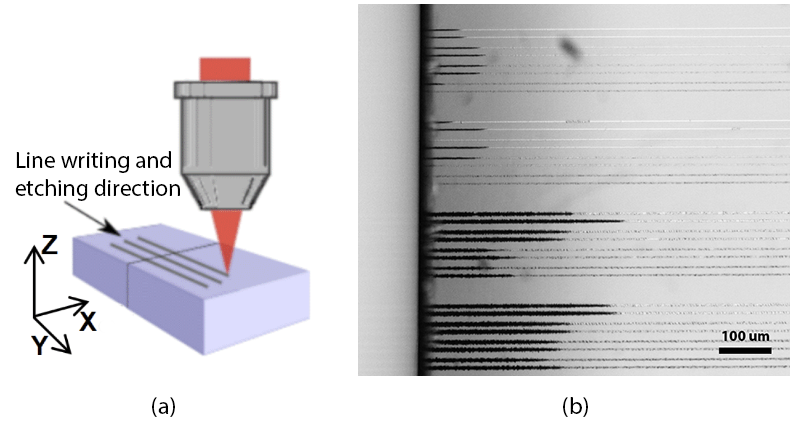
Etching rates are determined by writing lines at a depth of 100 m in fused silica with a CARBIDE (Light Conversion) laser system (setup shown in fig. 1 a) using different writing parameters: energy, repetition rate, pulse duration, pulse density, burst mode. The NA of our setup is 0.22. The fused silica samples are etched in 80 \(^{\circ{}}\)C KOH for an hour before measuring the etched out channel lengths with an optical microscope (fig. 1 b). Simple 3D structures are also written at the surface to check for crack formation.
We observe that the use of GHz and MHz bursts can highly increase etching rates. The effect is most prominent for lines written using short pulse durations (400 fs) where no etching was achieved when using single pulses but etching was observed for lines written with GHz or MHz bursts. For longer pulse durations this effect becomes less noticeable and for pulse durations over 2 ps the maximum etching rates are the same for lines written with and without burst mode. By writing simple 3D structures we determine that good etching quality can be achieved with pulse durations of about 1-2 ps. The use of MHz or GHz bursts of 2 or 3 pulses can help reduce crack formation in this regime. We also find a writing regime with 200-400 fs pulse durations and the use of MHz bursts with 10 pulses where no cracks were observed in the etched structures. For longer pulses up to 10 ps we observe an increase in cracking as well as the formation of circularly shaped modifications.
Our results show that by using pulse bursts etching rates can be increased and etching can be achieved even with short pulse durations. By using these shorter pulses crack formation can be reduced.