
Optical components are essential in laser systems used to direct and control laser-generated radiation. Demands for optical elements, including mirrors, are rapidly increasing, therefore making such elements a weakest link when it comes to laser-induced damage threshold (LIDT). To gain benefits in optical resistivity or spectral performance, a fairly new method is developed using nanostructured thin films coated by GLancing Angle Deposition (GLAD) method. Conventional titanium oxide mirrors with low LIDT can be enhanced by depositing an additional “upgrade” [1] coating to improve LIDT. In order to achieve this, environmental stability measurements are investigated.
The aim of this study was to investigate the dependence of the nanostructured coating stress on humidity. The upgrade 5-layer coating consists of 2 porous silica layers with low refractive index deposited at substrate tilt angle of 70° and 3 dense hafnia (deposited at 0°) with high refractive index. Porous films tend to absorb water and can induce some instabilities depending on humidity in the environment. Water molecule movement changes the intrinsic stress values of the film a considerable amount, and may lead to coating cracking.
To test this hypothesis, a gas isolating chamber was constructed around an interferometer to measure the stress induced surface curvature of porous coatings under different humidity values. At first you insert the porous film, measure the peak-to-valley values, and start introducing nitrogen gas, to lower the humidity. To get higher humidity a container with a water salt mixture [2] was placed inside to create a more humid atmosphere. The measurements were carried out at several different levels of humidity. Highest and lowest achieved humidity was about 5 rh% and 79 rh% respectively.
The obtained results demonstrate that as we decrease the humidity the stress increases. The peak-to-valley values changed from 0.625 λ to 1.202λ (see Figure 1), as humidity was lowered to 5rh%. This change indicates that by having a higher humidity the power value may go down, and if the humidity is changed aggressively, it may lead to cracking of the coating. 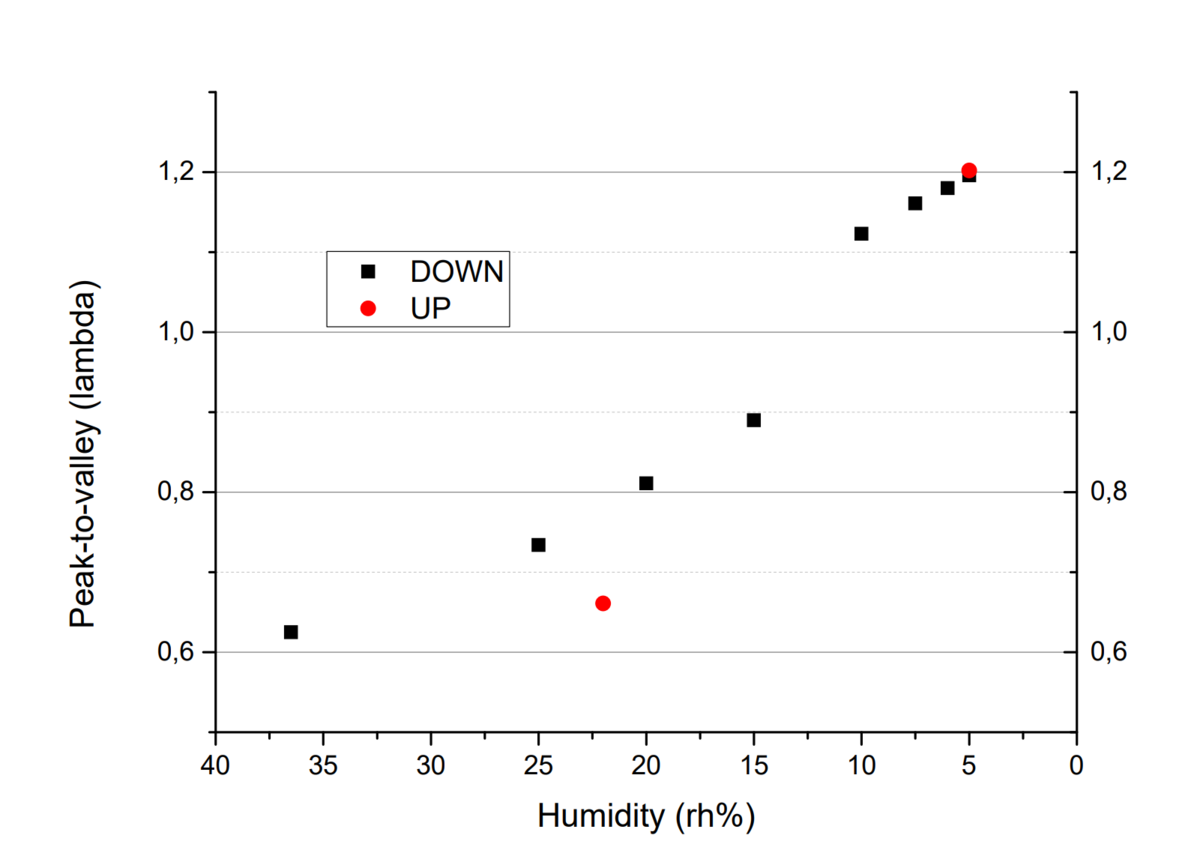
All in all, we coated GLAD coatings on titanium/silicon mirrors which had low intrinsic stress. Afterwards it was discovered that the stress was dependent on humidity, and a lot of problems arose. If these issues were dealt with, such developed coatings could be of major use as they are aimed to be applied in ultrafast laser systems.