
$ Si\(_{b}\) TiO\(_{c}\) COMPOUNDS} Due to their high thermal resistence, biological compatibility and modifiable optical properties, Ca\(_{a}\)Si\(_{b}\)TiO\(_{c}\) compounds are widely used in bioceramics, glazes [1], semiconductors and photocatalytic materials [2]. Ca\(_{a}\)Si\(_{b}\)TiO\(_{c}\) compounds are produced by high temperature (1200-1400°C) solid phase sintering of crystalline raw materials (CaO, SiO\(_{2}\), TiO\(_{2}\)) [3]. In contrast, the use of initial dissolved organic (Ca/Si/Ti) salts and sol-gel synthesis can reduce the synthesis temperature to ~1000 °C. However, the application of this method is limited by expensive raw materials and high solvent consumption. Therefore, this work proposes to synthesize (sol-gel) an amorphous TiO\(_{2}\) additive, study its influence on the formation of calcium silicate hydrates under hydrothermal synthesis conditions and their crystalisation into Ca\(_{a}\)Si\(_{b}\)TiO\(_{c}\) compounds during sintering. It is assumed that, unlike its crystalline forms, amorphous TiO\(_{2}\) can intercalate into calcium silicate hydrates’ lattice and that hydrothermal curing will lead to formation of purer Ca\(_{a}\)Si\(_{b}\)TiO\(_{c}\) phases at lower sintering temperatures.
In this work, amorphous titanium dioxide was prepared in accordance to our earlier experiments [4]. Two base samples were prepared by mixing amorphous TiO\(_{2}\), amorphous SiO\(_{2}\) and CaO equal to molar ratio of 1. One of the samples was then mixed with H\(_{2}\)O to reach the water/solid ratio of 10. The hydrothermal synthesis was performed under saturated steam pressure of 15 bar at a temperature of 200 °C for 4 hours. After treatment, synthesis products were filtered, dried and sieved (<80 μm). Both raw crystaline and hydrothermally cured mixtures were then calcinated at temperatures of 900-1200 °C for 1 hour. Synthesis products were characterized by XRD and STA instrumental methods.
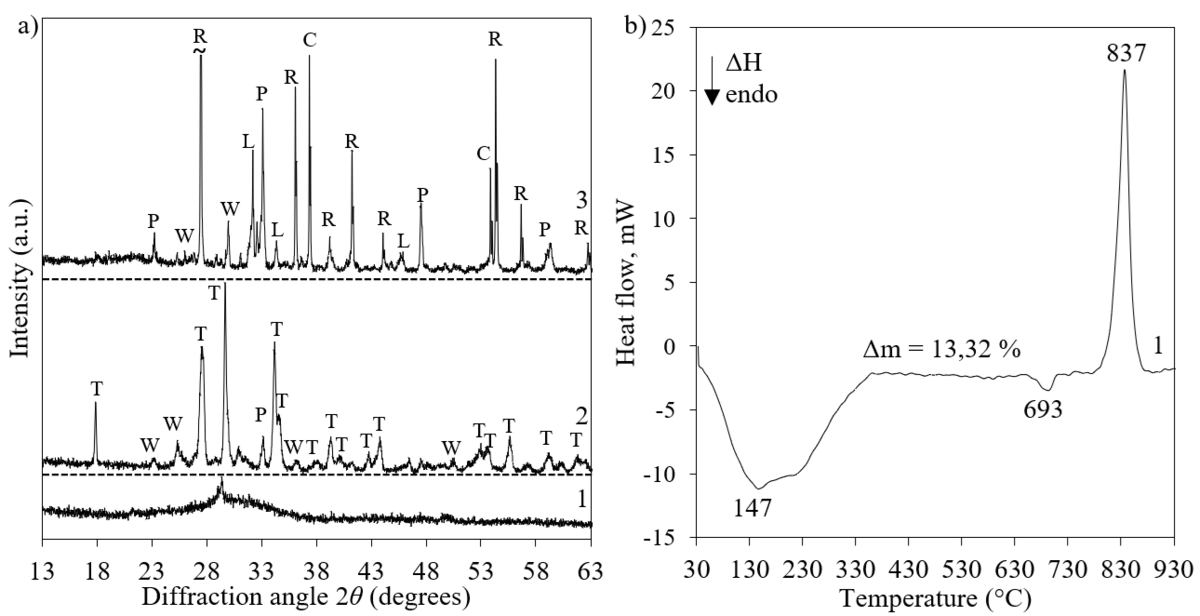
The most important aspect of two-stage preparation method is the formation of homogenous amorphous CaO-SiO\(_{2}\)-TiO\(_{2}\)-H\(_{2}\)O compounds (I stage) {(Fig 1. a. 1)}, which promote the formation of dominant Ca\(_{a}\)Si\(_{b}\)TiO\(_{c}\) compounds during calcination (II stage) {(Fig 1. a. 2)} at low temperatures {(Fig 1. b; 800-880 °C)}. Meanwhile after calcination of dry sample, it was determined that crystaline CaO-SiO\(_{2}\)-TiO\(_{2}\) mixture did not form Ca\(_{a}\)Si\(_{b}\)TiO\(_{c}\) compounds, as secondary phases rutille, lime and calcium silicates (larnite and wollastonite) are dominant in the synthesis products {(Fig 1. a. 3)}.