
The advantages that organic light emitting diode (OLED) based technologies offer in terms of brightness, viewing angle, contrast ratio, production cost, etc. are not rivalled by liquid crystal-based displays. In this study we present novel methylpyrimidine-carbazole derivatives and influence of complication of donor arm structure to emissive properties. Thermally activated delayed fluorescence (TADF) is a now well-known emission mechanism which make it theoretically possible to achieve 100% internal quantum efficiency.Novel D2-D1-A-D1-D2 emitters with the donor arm composed of a double twisted donor-donor moieties provide additional routes for charge-transfer (CT) emission. Here we show that a structural complication of the donor arm by additional donor moiety, i.e., from D-A-D to D2-D1-A-D1-D2 yields a transition from a dual to triple CT band with corresponding red shift and increasing contribution of the low-energy emission components. The observed relationship between complexity of the donor moiety and multicomponent CT emission band in various D-A-D structures provides a clue for design of thermally activated delayed fluorescence emitters with controllable emission properties. Figure 1 depicts photoluminescence spectra, chemical structures and HOMO-LUMO distribution of new compounds. 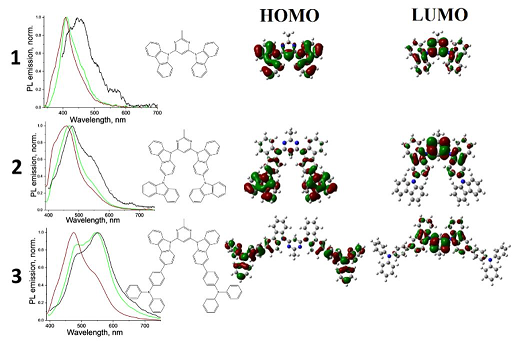
DESIGN OF A TWISTED DOUBLE DONOR IN CARBAZOLE-METHYLPYRIMIDINE-BASED EMITTERS LEADING TO THE TRIPLE CHARGE-TRANSFER EMISSION
Dovydas Blaževičius1, Gintarė Kručaitė1, Saulius Grigalevičius1, Oleg Dimitriev2
1 Department of Polymer Chemistry and Technology, Faculty of Chemical Technology, Kaunas University of Technology, Lithuania
2 V.E. Lashkaryov Institute of Semiconductor Physics, NAS of Ukraine, Ukraine
Fig. 1. PL emission spectra (green - chloroform, brown – THF, black - acetone solutions, all 10-5 M), chemical structures, HOMO and LUMO distribution