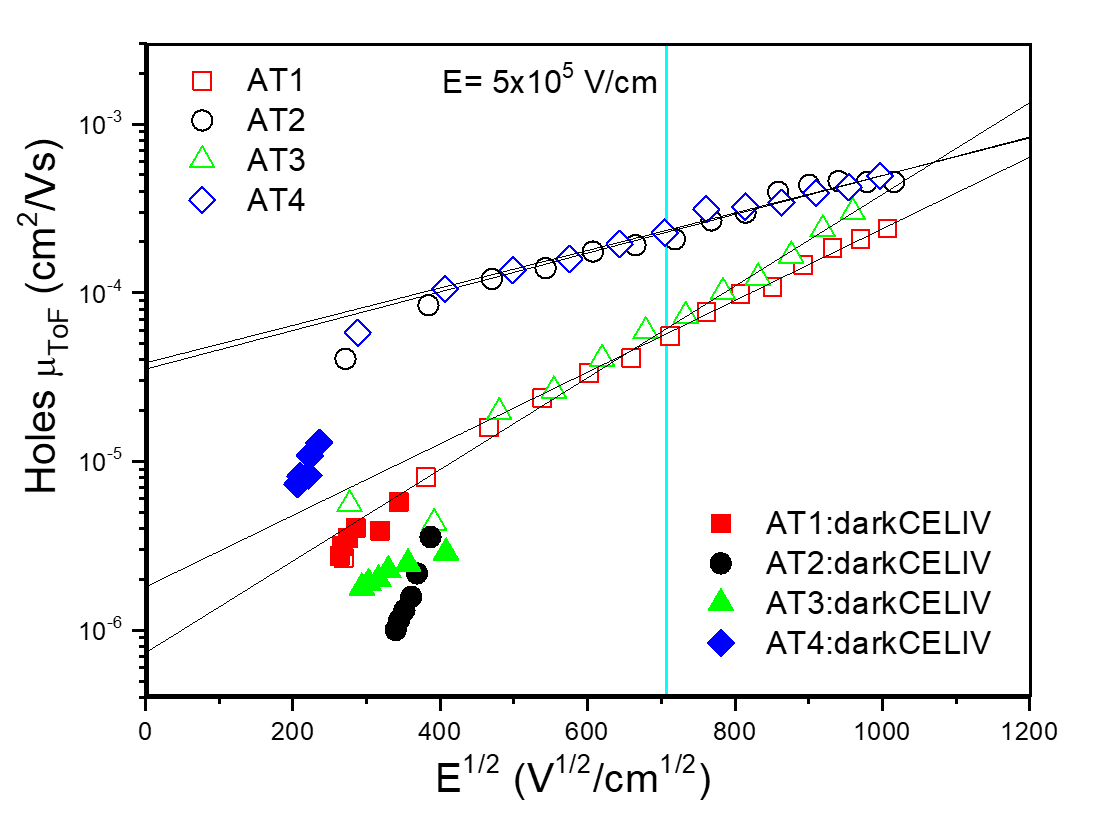
Organic light-emitting diodes (OLEDs) have gained significant attention due to their flexibility, high efficiency, and low manufacturing cost [1]. This technology has been widely implemented in display and solid-state lighting applications [2]. To achieve highly efficient devices, a multilayered structure is recommended. One approach for improving efficiency is the incorporation of a hole transporting layer (HTL), which reduces the energy barrier for the excitons, enhances hole transportation and recombination within the emissive layer, and prevents charge accumulation [3]. An ideal hole transporting material should exhibit high thermal and morphological stability, an optimal highest occupied molecular orbital energy level, and compatibility with adjacent layers to minimize interfacial defects [4]. In this study a series of novel metal-free organic compounds featuring carbazole and dibenzofuran moieties were meticulously designed, synthesized, and characterized for their potential as HTLs for OLEDs. Photophysical studies revealed that all the compounds exhibit room-temperature phosphorescence in an inert matrix, along with excellent thermal stability, with decomposition temperature (T\(_{d-5\%}\)) exceeding 400 \(^{o}\)C and glass transition above 100 \(^{o}\)C. The hole transporting capabilities of the compounds were determined to be 2.28 × 10\(^{-4}\) cm\(^{2}\)/Vs and 2.34 × 10\(^{-4}\) cm\(^{2}\)/Vs at an electric field of 5× 10\(^{5}\) V/cm, confirming their suitability as HTLs for OLED applications. The compounds were tested as the HTLs in red phosphorescent OLEDs, resulting in external quantum efficiency of 18.2% and a low turn on voltage of 4.39V, with negligible difference compared to the reference device.