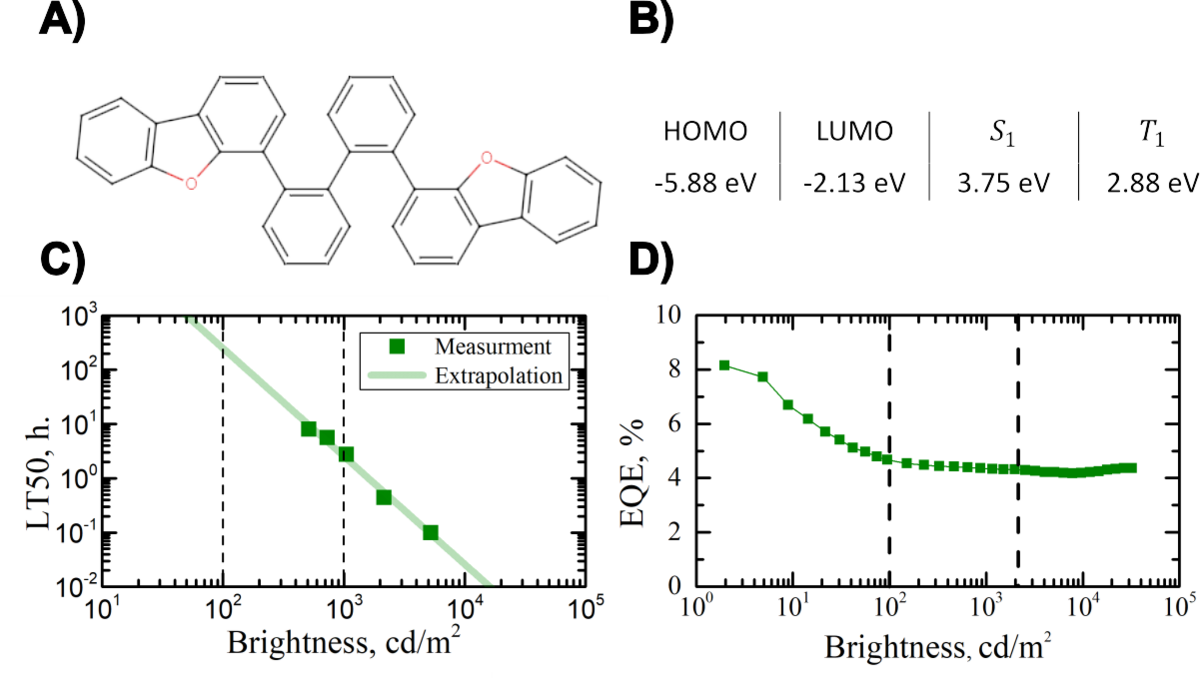
In recent years, thermally activated delayed fluorescence (TADF) has become a well-established mechanism for achieving an internal quantum efficiency of 100% in organic light-emitting diodes (OLEDs)\(^{1}\). However, for efficient device performance, emitter molecules must be doped into a suitable matrix. This matrix material should facilitate uniform charge carrier distribution and stabilize the emitter, thereby minimizing the risks of aggregation and degradation. To prevent excitation transfer from the emitter back to the matrix, compounds with a high triplet energy level are necessary\(^{2}\).
The aim of this research was to investigate -[2-(2-dibenzofuran-4-ylphenyl)phenyl]dibenzofuran and its applicability as an OLED host. The material’s energy structure was obtained from absorption and emission measurements and cyclic voltammetry. Optimal emitter-host concentration was determined from the highest photoluminescence quantum yield (PLQY). Fabricated OLED devices were electro-optically characterized to determine their efficiency and stability properties.
The compound was determined to have a triplet energy of 2.88eV, making it suitable for hosting the DMeCzIPN emitter. The optimal emitter concentration in the host was found to be 20%, which resulted in the highest measured PLQY of 66.3%. OLEDs were fabricated using the vacuum deposition method. The devices exhibited a turn-on voltage of 2.6V and achieved a luminance of \(32400\,\text{cd}/\text{m}^2\) at a current density of \(332\,\text{mA}/\text{cm}^2\). The OLEDs demonstrated an external quantum efficiency of up to 8%, with an efficiency decrease of 0.34% within the commercially relevant brightness range of \(100\,\text{cd}/\text{m}^2\) to \(1000\,\text{cd}/\text{m}^2\). Under constant current operation, the devices required 245 hours and 2.5 hours to degrade to half of their original brightness at initial luminance levels of \(100\,\text{cd}/\text{m}^2\) and \(1000\,\text{cd}/\text{m}^2\), respectively.