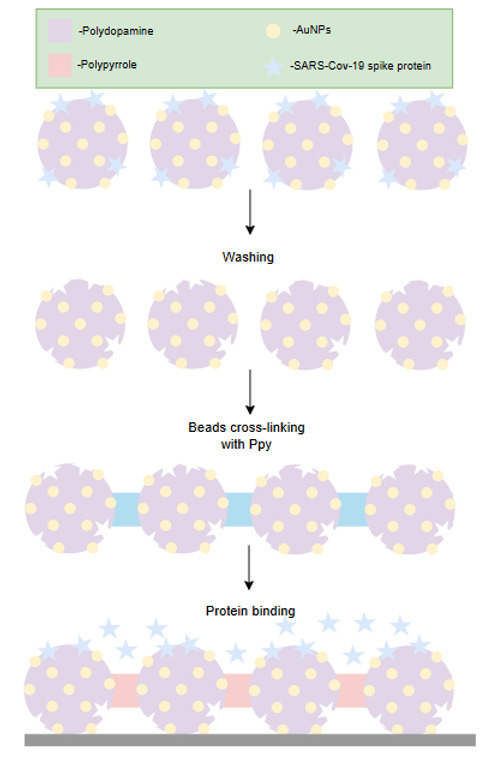
There is a need for a cheaply available and sensitive Molecularly Imprinted polymer (MIP) based biosensor for SARS-CoV-2 spike protein detection.
MIP biosensor for selective detection of the SARS-CoV-2 spike protein in aqueous solutions via electrochemical impedance spectroscopy (EIS) of polydopamine (PDA)-based biosensor on a glassy carbon (GC) is promising in an aqueous solution via outer-sphere electron transfer from redox Fe(CN)6.
A sandwich-like architecture (GC electrode → PPy → PDA-MIP doped with AuNP → secondary PPy interconnecting layer) forming a conductive hybrid polymer nanostructure which is required for the MIPs EIS measurement upon binding of the target. Initially Ppy is electropolymerized on top of the electrode for continuous coverage of PDA-MIP. The PDA-MIP layer is applied via drop-casting, the MIP is fabricated via pH shift polymerization of dopamine in the presence of the spike pr otein template and AuNP dopant, ensuring non-denaturing conditions of the spike protein. Followed by a secondary PPy layer polymerized via cyclic voltammetry (CV), interconnecting the PDA-MIPs on the surface.
MIP biosensor exploits the conductive properties of PDA, PPy, and AuNPs, providing a platform for SARS-CoV-2 spike protein detection with high sensitivity and low limit of detection.