
Tethered bilayer lipid membranes (tBLMs) are artificial structured membranes that are used to imitate natural cell membranes, which helps us to analyze how biological membranes work. tBLMs are constructed of a lipid bilayer that is anchored to the solid support, which is typically to a gold surface, by the self-assembled monolayer (Figure 1). 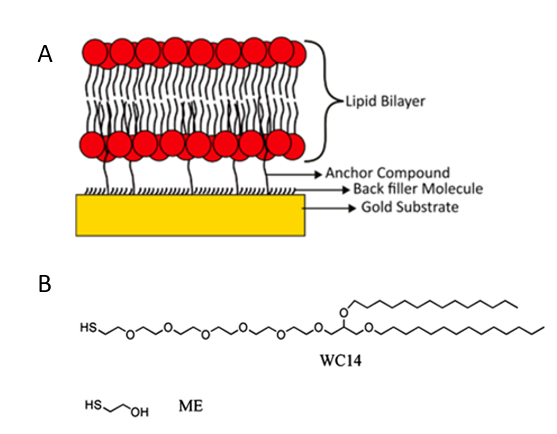
Self-assembled monolayer consists of anchor thiol WC14 (20-tetradecyloxy-3,6,9,12,15,18,22-heptaoxahexatricontane-1-thiol) and back-filler β-mercaptoethanol molecules. The WC14 molecule is composed of three structural segments: the thiol group that attaches the molecule to the surface, the ethylene glycol that acts as a spacer, and two alkyl chains that immobilize the lipid bilayer. The structure and surface concentration of the anchor molecules significantly affect the biophysical properties of the tBLMs, such as integrity and fluidity. These parameters directly affect sensitivity to membrane-damaging agents such as pore-forming toxins.
In this work, we intended to study how the structure and orientation of anchoring molecules change on the gold surface when employing different WC14 homologs and concentrations. For that, we analyzed two different chain lengths of anchor molecules: WC14 with 6 and 4 ethylene glycol segments. By using spectral markers of surface-enhanced infrared absorption spectroscopy (SEIRAS), we found that the lower concentrations of WC14 anchor molecule and the shorter ethylene glycol segment lead to more flexible and distorted spacer segment [3].