
Plastic waste is one of the greatest challenges facing the world today. Mechanical recycling is still highly limited in efficiently recycling plastic waste – secondary plastics lose their mechanical properties due to thermo-oxidative degradation during the process. Also, the process requires homogeneous and clean streams. Consequently, the main treatment method in Europe remains incineration for heat energy recovery, which emits large amounts of CO2, accelerating global warming. In the present research a low carbon footprint process – pyrolysis of plastic packaging waste was investigated, estimating the product distribution dependence on pyrolysis conditions along with conversion rates determination by Arrhenius approach and a single first-order reaction model. The temperature influence was investigated to up to 1400 °C maintaining the samples for 0.5–420 s to estimate the decomposition rate, measuring the weight changes in a lower scale (wire mesh reactor) and a higher scale – fixed bed reactor with a high-temperature furnace. The gaseous products evolved were analysed by mass spectrometry and a solid product by Raman spectroscopy and scanning electron microscopy. The influence of the slow heating rate was estimated by carrying thermogravimetric analysis combined with Fourier transform infrared spectroscopy (FTIR) and gas chromatography-mass spectrometry (GC–MS), which results are illustrated in Figure 1. The main components of the plastic packaging feedstock were polypropylene and polyethylene terephthalate, established by simultaneous thermal analysis. Pyrolysis conditions determined the conversion process and the composition of pyrolysis volatile organic compounds and reaction kinetics. Pyrolysis temperature elevation positively influenced the yields of lower molecular weight hydrocarbons and hydrogen gas and reaction rate with varying effect. Additionally, the formation of carbon black, an industrially valuable product was confirmed during flash pyrolysis carried out in a high-temperature tube reactor. Overall, this research enhances the understanding and development of plastic waste upcycling via pyrolysis targeting high-value products recovery, aligning with circular economy principles. 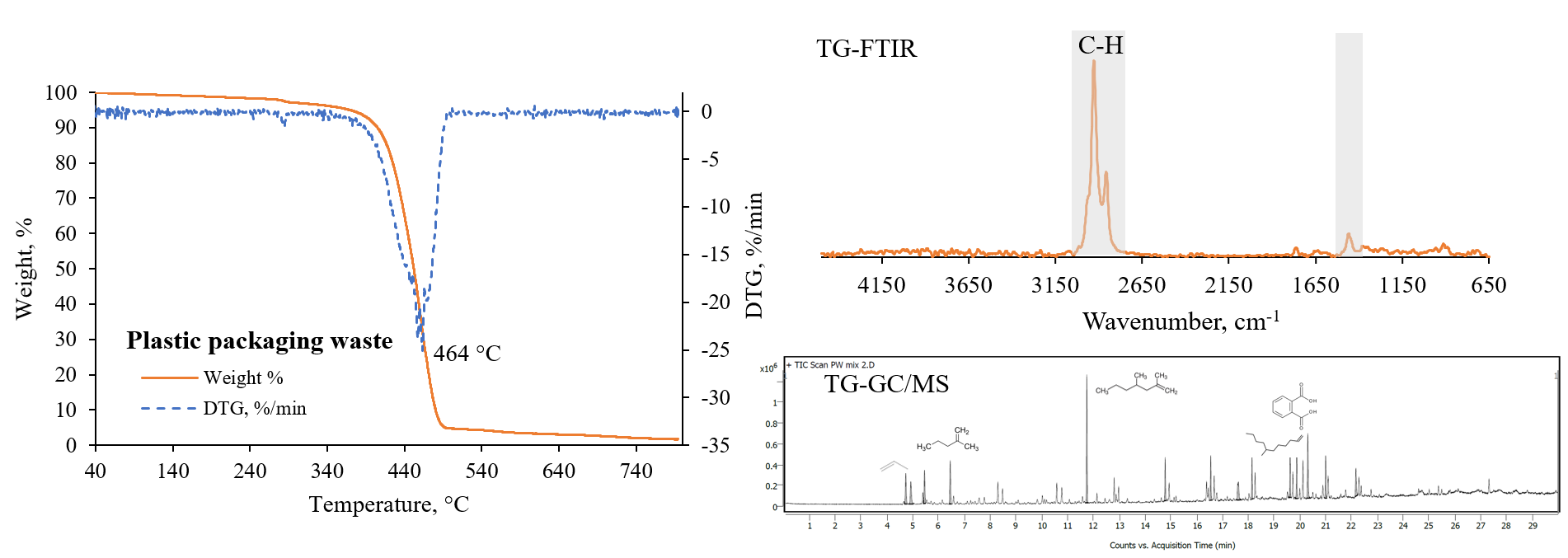
INFLUENCE OF PROCESS CONDITIONS ON THE PYROLYTIC CONVERSION OF PLASTICS: FOCUS ON THE REACTION KINETICS AND PRODUCT DISTRIBUTION
Ieva Kiminaitė1, Simon Schuler2, Clara Leonie Brigitte Eckert2, Vilmantė Kudelytė1
1 Lithuanian Energy Institute
2 Technical University of Munich
[1] Plastics Europe. The Circular Economy for Plastics – A European Analysis 2024. 2024.
[2] Jin H, Gonzalez-Gutierrez J, Oblak P, Zupančič B, Emri I. The effect of extensive mechanical recycling on the properties of low density polyethylene. Polym Degrad Stab 2012;97:2262–72. https://doi.org/10.1016/j.polymdegradstab.2012.07.039.
[3] Papari S, Bamdad H, Berruti F. Pyrolytic conversion of plastic waste to value-added products and fuels: A review. Materials (Basel) 2021. https://doi.org/10.3390/ma14102586.
[4] Karaduman A, Şimşek E., Çiçek B, Bilgesü A. Flash pyrolysis of polystyrene wastes in a free-fall reactor under vacuum. J Anal Appl Pyrolysis 2001;60:179–86. https://doi.org/10.1016/S0165-2370(00)00169-8.
[5] Bortoluzzi JH, Cristiano R, Gallardo HA, Carasek E, Soldi V. Use of the SPME-GC-MS technique to study the thermal degradation of isotactic polypropylene: Effects of temperature and reaction time, and analysis of the reaction mechanism. E-Polymers 2008;8. https://doi.org/10.1515/epoly.2008.8.1.193.