Carbonic anhydrases (CA) are ubiquitous enzymes that catalyze the reversible hydration of carbon dioxide into bicarbonate (\(\text{CO}_2 + \text{H}_2\text{O} \rightleftharpoons \text{H}_2\text{CO}_3\)).These enzymes play a vital role in physiological functions such as pH regulation and calcification. Among the fifteen human CAs, we focused on CA VA and CA VB, the only mitochondrial isozymes that provide bicarbonate ions during gluconeogenesis and lipogenesis[1].
The investigation of carbonic anhydrases is crucial for drug design due to their links with various pathological conditions, including cancer and obesity[2]. Our research aimed to produce recombinant proteins for human mitochondrial carbonic anhydrases CA VA and CA VB. In previous efforts to produce recombinant functional CA VA and CA VB, we encountered low solubility and aggregation challenges. To improve recombinant protein stability, we hypothesized that removing cysteine residues from the protein sequences would be beneficial. Using targeted mutagenesis, we replaced each cysteine with serine or alanine.
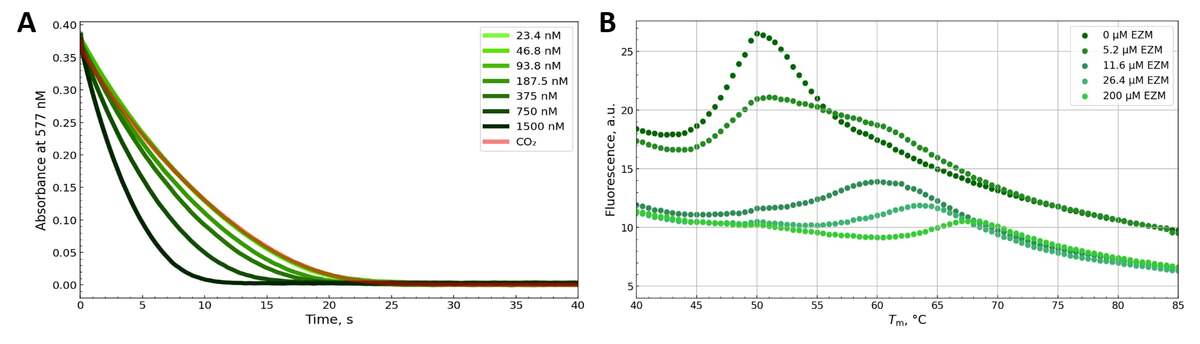
After completing the mutagenesis, we expressed the target proteins in Escherichia coli and purified them. We then evaluated the CO\(_{2}\) hydratase activity of the recombinant CA VA and CA VB proteins by stopped-flow method and inhibitor binding using fluorescence thermal shift assay, as illustrated in Figure 1.