In recent decades biocatalysis has become indispensable as a more selective, ecological and ultimately more efficient alternative to some traditional chemical routes. The use of enzymes or microorganisms is especially advantageous when stereo- and/or regio- selectivity and mild reaction conditions are required [1].
Although biocatalysis provides profound benefits, achieving desired biocatalytic activity comes with its own set of challenges. Naturally occurring enzymes do not often possess synthetically relevant catalytic activity [2]. Enzyme engineering is an approach which utilizes known enzyme structural and functional motifs to create proteins that can catalyze a desired reaction. However, these methods require vast knowledge of enzymes possessing similar to desired catalytic activity. To this extent, high-throughput functional screening methods, which enable the discovery of enzymes with novel catalytic activities from metagenomic libraries, are necessary [2].
Urethanes are mostly encountered in the form of a polymer – many household items such as mattresses, sponges, glues and many others are made from polyurethane (PU). PU composes 8% of all annual plastic production, which brings forth the question of PU waste management [3]. Several methods of chemical PU recycling exist, but none are practically used because of their high costs and inability to effectively separate and utilize the products of these processes. The use of urethanases can counter several of these problems, making PU recycling a reality [4]. Furthermore, urethanes are used in their monomeric form in synthetic chemistry as protecting groups and in the pharmaceutical [5] and agricultural industries [6] as drugs and pesticides. It is possible to use urethanases for selective and mild condition synthesis of these compounds [7].
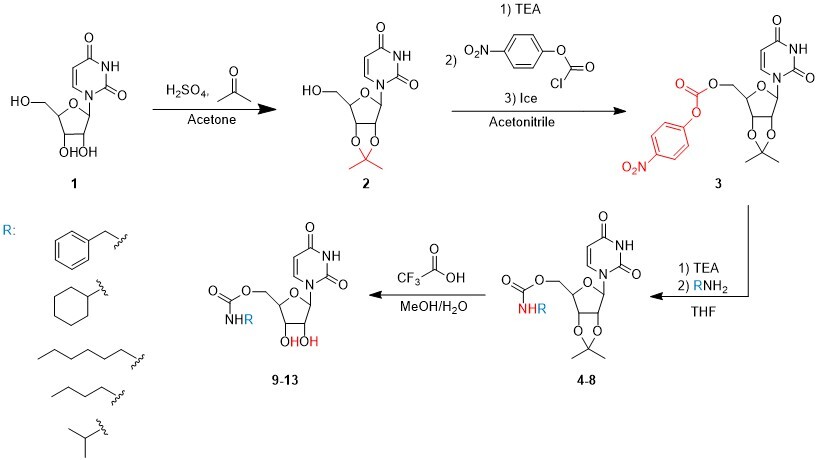
No high-throughput methods for the selection of urethanases from metagenomic libraries have been reported. To this end, our team is developing such methods based on E. coli uridine auxotrophs. Genes from metagenomic libraries are transferred into E. coli uridine auxotrophs, which are then grown on minimal media supplemented with different uridine analogs containing urethane fragments. Based on previous achievements, such selection method is expected to be highly efficient [8][9]. The first step in the development of such approach is the synthesis of the appropriate 5’-carbamoyluridine analogs (Fig. 1). The synthesis of 2’,3’-isopropyledeneuridines with different 5’-carbamoyl groups (-8) has been achieved with varying total yields (41%-46%) as well as the 2’,3’ deprotection of 5’-butylcarbamoyluridine () with a yield of 95%.