
Collagen is a key protein of the extracellular matrix, responsible for the mechanical strength of tissues and their structural integrity. The stability of the collagen triple helix largely results from the presence of proline and hydroxyproline, which determine the conformational flexibility of the peptide chain. However, natural variants of collagen exhibit limited thermal stability, which poses a significant challenge in the context of biomedical applications, such as tissue engineering or materials for tissue regeneration.
This study focuses on the modification of collagen by replacing proline or hydroxyproline with a chiral bicyclic 2-azabicycloalkane fragment or its mono- or dihydroxylated derivative. This approach aims to enhance the thermal stability and structural integrity of collagen while preserving its biological functionality. By systematically investigating the effects of these modifications, we hope to develop collagen-based materials that can better withstand physiological conditions and improve outcomes in regenerative medicine.
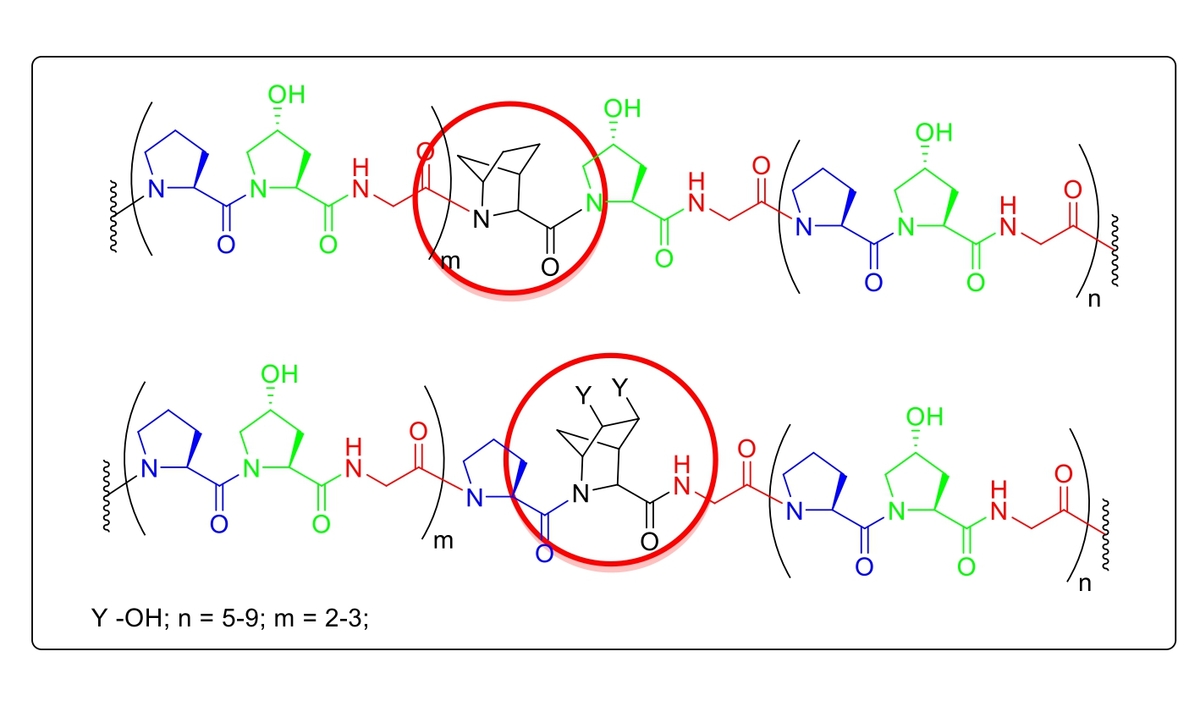
This modification aims to enhance the stability and functionality of collagen-based materials for various biomedical applications. By analyzing the structural and mechanical properties of these modified collagens, researchers hope to uncover new potential uses in tissue engineering and regenerative medicine. Replacing proline with a slightly larger 2-azabicycloalkane system may significantly increase the stability of the collagen triple helix. 2-Azabicycloalkane systems are structurally more rigid than proline, which may lead to better preorganization of collagen chain conformations and increased stability of the helical structure [1]. This stabilization may result from the limited conformational flexibility of the pyrrolidine ring and its influence on the trans/cis equilibrium of the peptide bond, potentially reducing the tendency of helix dissociation at higher temperatures [1].
Additionally, if instead of hydroxyproline, a bicyclic 2-azabicycloalkane analogue with one or two hydroxyl groups is introduced, additional hydrogen bonding between adjacent chains in the triple helix will be provided, which may further stabilize the entire structure. Hydroxyl groups in 2-azabicycloalkane systems can participate in the formation of hydrogen bond networks similarly to hydroxyproline while simultaneously contributing to greater control over structural preorganization.
The proposed strategy for collagen modification may lead to the development of materials with enhanced thermal and mechanical stability, making them attractive for biomedical applications such as implants, regenerative materials, or tissue engineering.