Amyloids are protein aggregates with an insoluble, fibrillar structure formed by improper β-sheet folding. These aggregates can accumulate in various organs, leading to amyloidosis, which includes Alzheimer’s disease, Parkinson’s disease, and type II diabetes mellitus. Recent studies highlight liquid–liquid phase separation (LLPS) as a key step in amyloid formation. While LLPS plays a crucial role in cellular organization, its dysregulation can contribute to neurodegenerative and oncological diseases. Increased protein concentration during LLPS may trigger changes that promote fibril formation. Researchers are exploring small-molecule compounds such as bis-ANS, ATP, polyphosphates, RNA, heparin, and specific chaperones to regulate this process, although their mechanisms remain partially understood [1].
Recent studies indicate that the imidazo[2,1-b][1,3]thiazine scaffold represents a promising pharmacophore for inhibiting amyloid protein aggregation. Its capacity to interact with biological macromolecules suggests that imidazo[2,1-b][1,3]thiazine-based derivatives are potential candidates for modulating phase separation processes implicated in neurodegenerative diseases [2].
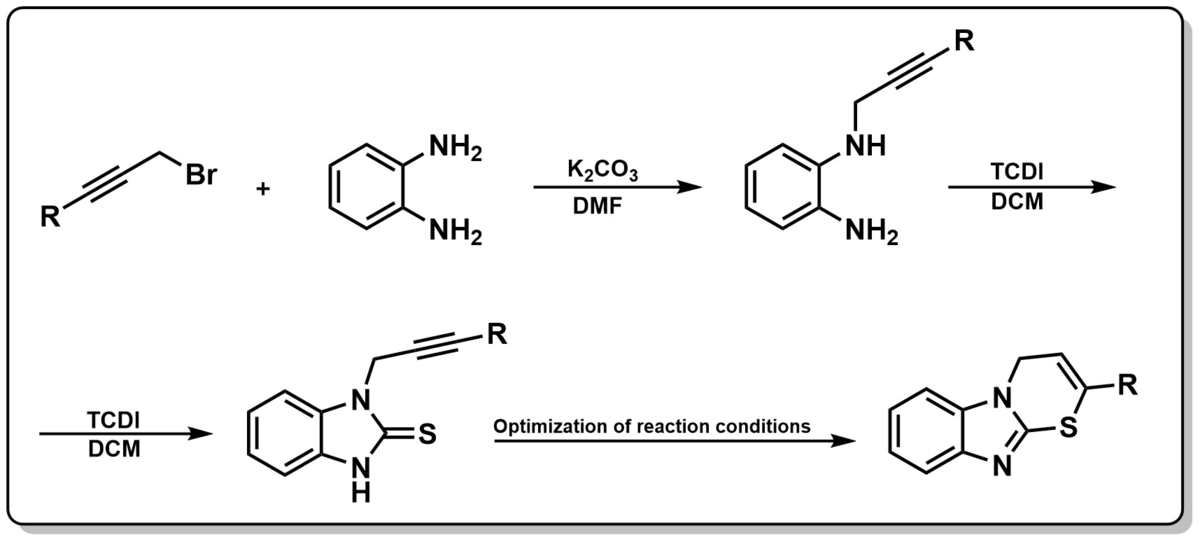
This study aims to synthesize various benzimidazo[2,1-b][1,3]thiazines with potential amyloid aggregation inhibitory properties. The newly developed compounds feature a substituent at the C\(_{2}\) position adjacent to the double bond, representing a novel structural modification. Given the novelty of these compounds, it is crucial to first establish the most efficient synthetic pathway. The synthesis of the starting compound, 1-(3-phenylprop-2-yn-1-yl)-1,3-dihydro-2H-benzo[d]imidazole-2-thione, was achieved via the alkylation of 1,2-diaminobenzene with (3-bromoprop-1-yn-1-yl)benzene, followed by the condensation of the resulting intermediate with thiocarbonyldiimidazole. Optimization of the cyclization reaction conditions is currently underway to enhance reaction selectivity by employing various coinage catalysts.