
Benzenesulfonamides are widely explored due to their wide range of potential pharmaceutical uses as anticancer, antibacterial and antifungal drugs [1]. As well as alkylated imidazoles which bear anticancer activity and ketoximes which garnered attention for their potent antibacterial properties [2, 3].
In this present study, α-aminoketone was obtained by reacting the primary amine with bromoacetophenone in H\(_{2}\)O and 1,4-dioxane mixture. 3,5-dichloro-4-((2-oxo-2-phenylethyl)amino)benzenesulfonamide () was synthesized by chlorination of compound with HCl in a presence of hydrogen peroxyde. Ketoximes and were synthesized by treating α-aminoketones , with hydroxylamine hydrochloride in methanol using sodium acetate as base. Oxoimidazole was yielded by treating α-aminoketone with sodium cyanate in glacial acetic acid, and mercaptoimidazole - by treating α-aminoketone with potassium thiocyanate in hydrochloric acid. The alkylation reactions of the synthesized imidazole derivatives and with ethyl iodide were investigated and it was found that by varying the reaction conditions, N-, S- and N,S-alkyl derivatives ,- could be synthesized. Molecular structures were confirmed via FT-IR, NMR spectra and elemental analysis. 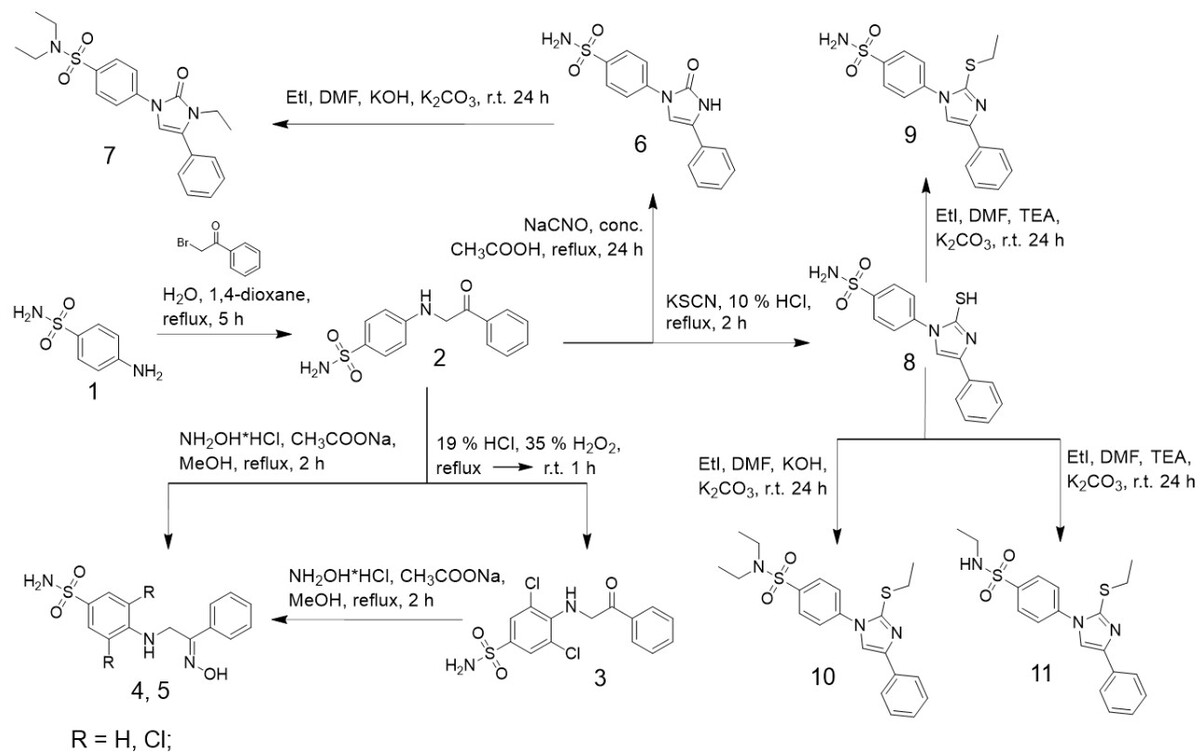
Synthesized compounds were evaluated against H69 human lung carcinoma cells and C. albicans, C. auris cultures bearing promising results.