Cavitands are a class of macrocyclic molecules possessing an intrinsic internal cavity that is capable of reversible binding to various guest molecules through various non-covalent interactions. Such (often selective) host-guest binding allows for various potential applications - molecular recognition for sensors [1], encapsualtion of hydrophilic molecules for drug delivery [2], or catalysis through proximity effect (to other molecules or reactive groups of the cavitand itself) [3]. However, currently available cavitands (such as cyclodextrins and calixarenes) have very limited potential due to the small range of variation for their size and geometry, poor functionalization capabilities and large symmetry enforced by their synthesis methods.
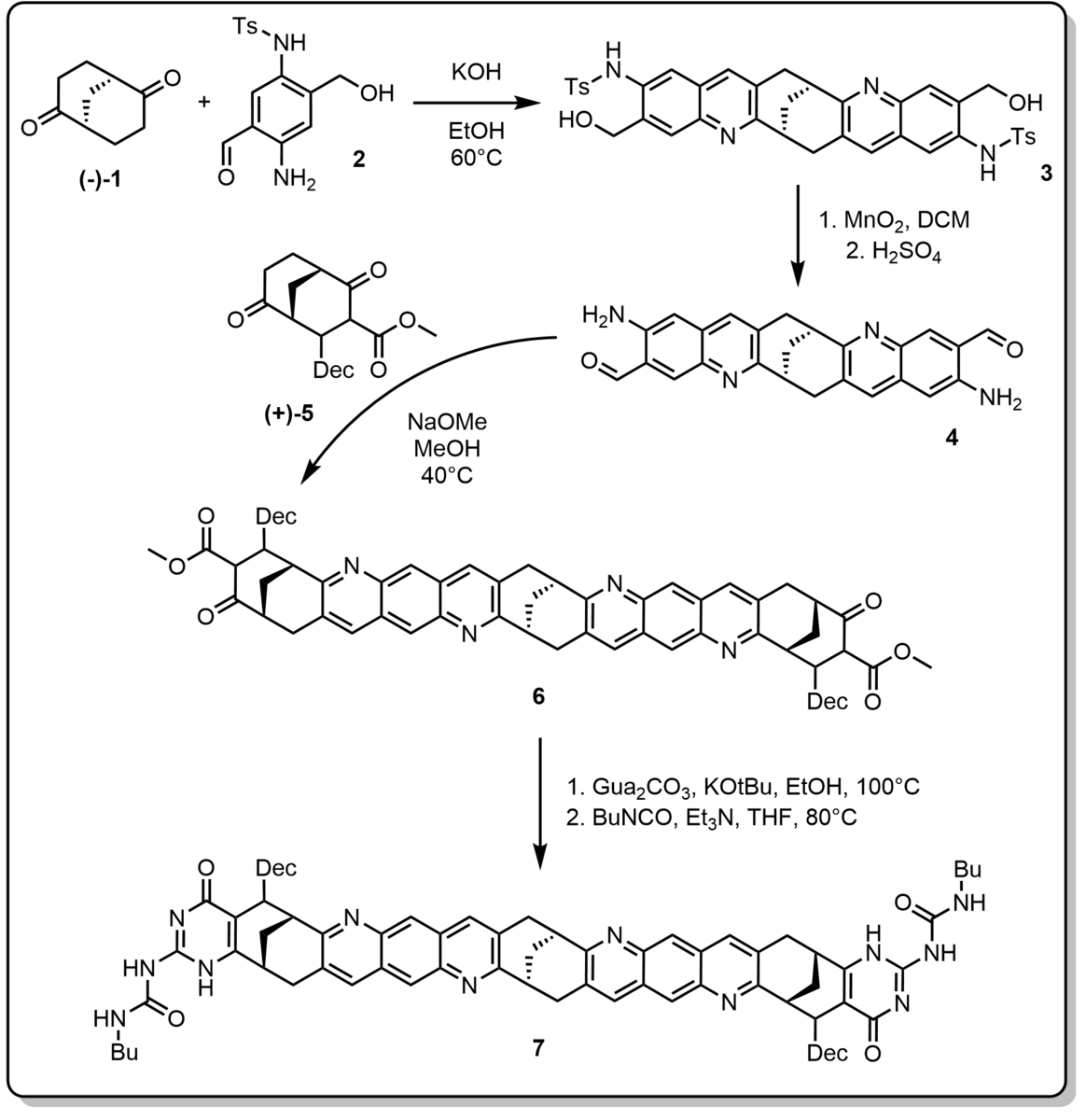
In this work, a novel supramoelcular tetrameric cavitand possessing a large cross-shaped cavity was prepared. It consists of the monomers , which can form quadruple self-complementary hydrogen bonds via the ureidopyrimidinone structures placed at the terminuses. The rigid structure of the monomer, resulting from the enantiomerically pure bicyclo[3.3.1]nonane derivatives (-)-1 and (+)-5 fused with aromatic linkers , forces a spatial arrangement that allows for the formation of cyclic cross-shaped tetramers through the ureidopyrimidinone hydrogen bonding. The presence of large discrete oligomeric structures in CDCl\(_{3}\) was confirmed by diffusion-ordered NMR spectroscopy (DOSY).
The synthesis procedure is also highly modular, potentially allowing for easy modification of cavity shape and size (e.g. by using different sized aromatic linkers, or completely changing the geometry with different bicyclo[3.3.1]nonane enantiomers). The procedure also allows for very versatile functionalization through multiple sites, such as Michael addition to unsaturated β-keto ester (succesfully performed with organocopper nucleophiles, alkynes & arylboronic acids) or formation of the ureidopyrimidinone with isocytosines derived from various amines. Future research includes the synthesis of more diverse cavitands based on this system, along with host-guest binding tests.