
Retinoids are a group of compounds chemically related to vitamin A and found all throughout the human body. Our visual system, for instance, is largely dependent on the isomerization of 11-cis-retinal to all-trans-retinal, and the following replenishment of 11-cis-retinal during the retinoid cycle [1]. Understanding the structure of such compounds is an important part of broadening the field of applications, and spectroscopic methods are often used for such tasks. While experimental methods provide us with accurate results, theoretical calculations may offer insights into molecular level of the compounds being investigated. Although similar compounds, such as various carotenoids, were successfully studied computationally in terms of vibrational and electronic spectra using density functional theory (DFT) [2], the same success has not yet been reproduced for retinoids in common solvents, especially regarding different cis-trans isomers, despite existing experimental results [3].
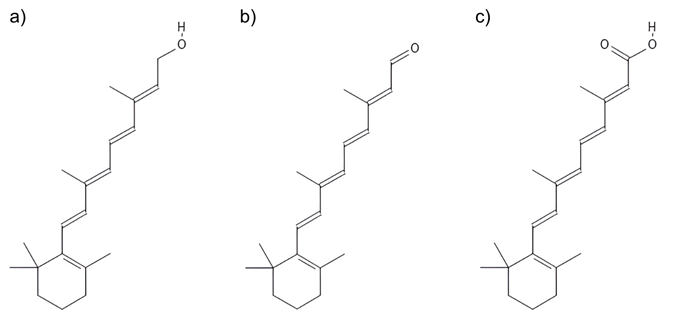
The primary goal of this study was to properly evaluate the electronic absorption spectra of retinoids in organic solvents for different cis-trans isomeric forms, as the absorption maxima of retinoids vary depending on the molecule’s configuration and the solvent used. Quantum mechanics/molecular mechanics (QM/MM) calculations, as well as DFT methods, were used in this work in order to investigate the systems more closely. The results provide more clarity about the electronic structure of retinoid molecules. Computations were performed using the resources provided by the High-Performance Computing Center “HPC Saulėtekis” at Vilnius University, Lithuania.