
Imidazoles are a large group of compounds that play important role in organic and medicinal chemistry. The specific structure of the imidazole ring with desirable electrophilicity makes its compounds very versatile for many biological applications. Derivatives of imidazoles attract considerable interest in the field of organic synthesis due to their wide spectrum of biological activity – these compounds contribute to various catalysis in enzymatic and endocytosis processes also this structures are known to have a wide variety of biological activities including antidiabetic, antioxidant, anti-amoebic, antihelmintic antibacterial, antimycobacterial, anti-inflammatory, antitumor, antidiabetic, antiviral, and antifungal activities [1−3]. 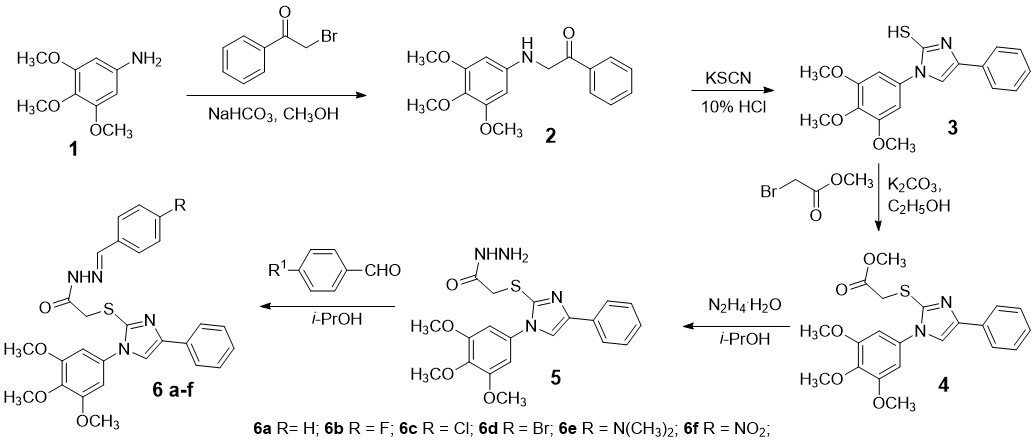
SYNTHESIS OF NEW 4-PHENYL-1-(3,4,5-TRIMETHOXYPHENYL)-1H-IMIDAZOLE-2-THIOLDERIVATIVES
B. Grybaitė1, A. Starkauskaitė1, V. Mickevičius1
1 Kaunas University of Technology, Department of Organic Chemistry, Radvilėnų pl. 19, 50254 Kaunas, Lithuania
Fig. 1. Synthesis of compounds −6.
[1] Du, J. et al., Eur. J. Med. Chem. 246, 114956 (2023).
[2] Liu, Y.C. et al., Bioorganic Med. Chem. 65, 116757 (2022).
[3] Gurjar, A.S. et al., Bioorg Med Chem. 26, 1511−1522 (2018).