
Health is a top priority in the modern world, and achieving it relies on effective pharmaceutical treatments. However, the excessive and improper use of antibiotics has led to a growing threat of pathogenic microbial resistance. The World Health Organization (WHO) has classified ESKAPE pathogens (Enterococcus faecium, Staphylococcus aureus, Klebsiella pneumoniae, Acinetobacter baumannii, Pseudomonas aeruginosa and Enterobacter spp.) as high-priority threats due to their resistance to certain antibiotics [1]. Therefore, developing novel methods for antibiotic delivery with enhanced properties is crucial to ensuring their effectiveness, preventing degradation by protective enzymes in the body, and avoiding the induction of further resistance mechanisms.
One promising approach to enhancing antibiotic efficiency is the formation of complexes with transport carriers, particularly phosphorus-containing polyesters. Such complexes are expected to facilitate the rapid penetration of active pharmaceutical ingredients across cell membranes.
Phosphorus-containing polyesters were synthesized using the Steglich esterification reaction, involving the interaction of N-stearoylglutamic acid with dipolyethylene glycol ethyl phosphate. The ester bonds within these macromolecules impart biodegradability, while the polymer structure, based on polyethylene glycols and amino acids, ensures the absence of cytotoxic and organotoxic properties. The presence of phosphate groups in the polyester structure allows for the conjugation of biologically active compounds, maintaining their essential pharmacological properties. Antibiotics are a notable example of such compounds.
The synthesized phosphorus-containing polyesters form dispersions in aqueous and physiological solutions, with nanometric-sized dispersed phases. It has been demonstrated that these aqueous dispersions exhibit surface-active properties, enabling self-stabilization and the solubilization of poorly water-soluble compounds.
Furthermore, it has been established that phosphorus-containing polyesters can bind and form complexes with antibiotics, including amoxicillin, oxytetracycline, benzylpenicillin, and doxycycline.
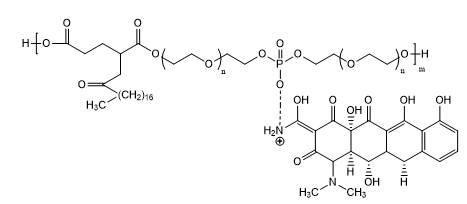
The antibacterial activity of these complexes was studied against Escherichia coli and Staphylococcus aureus. The minimum inhibitory concentration (MIC) of polyester-antibiotic complexes was found to be 4 to 5 times lower than that of the pure antibiotics.
The results indicate that these polyester-antibiotic complexes are highly effective, allowing for a reduced antibiotic concentration compared to pure drugs, which could help mitigate antibiotic resistance. The presented research findings were obtained with financial support from the National Research Foundation of Ukraine under the competition “Research Infrastructures for Conducting Advanced Scientific Studies” within the framework of project 2023.05/0015, titled “Development of Hydrogel-Based Emergency Care Solutions for Penetrating Abdominal Wounds as Part of the Establishment of a Research Center for Novel Polymer Materials for Medicine.”