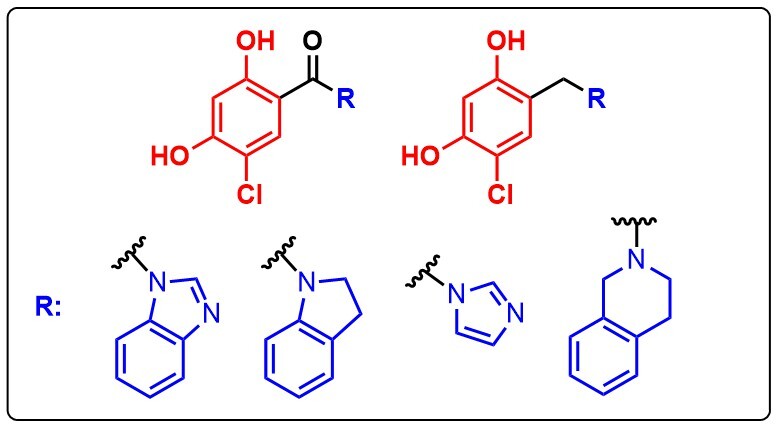
Hsp90 (Heat Shock Protein 90) is one of the most essential molecular chaperones involved in the maturation regulation of over 300 client proteins. Many of these proteins are closely related to hard-to-treat diseases such as cancer, neurodegenerative, and infectious diseases. For this reason, Hsp90 is a significant target in the search for synthetic inhibitors of this protein. One of its key pharmacophores is the resorcinol fragment, which inhibits Hsp90 activity due to hydrogen bonding between its hydroxyl groups and the Asp93 amino acid in the N-terminal domain of the protein. Consequently, compounds containing this structure are widely used to develop second-generation inhibitors [1].
To discover new structures that could enhance the inhibitory properties of resorcinol derivatives, it was decided to synthesize amides and amines containing the resorcinol fragment. The chosen base structure was 4-chlororesorcinol.
In the first step, an aldehyde group was introduced at the sixth position of 4-chlororesorcinol. In the second step, considering the subsequent synthetic steps, the hydroxyl groups in 4-chlororesorcinol were blocked using methyl iodide. In the third step, the synthesis diverges slightly: the aldehyde was oxidized to a carboxylic acid using a potassium permanganate, followed by condensation with target amines to produce amides. Another route involved the reduction of the aldehyde to alcohol, which was then brominated using phosphorus tribromide in a two-step reaction, immediately followed by nucleophilic substitution with target amines.
To complete this research, the only remaining step is to unblock the hydroxyl groups, which is currently in progress, and to investigate whether the compounds are suitable for Hsp90.