
Tissue engineering is a rapidly evolving field aimed at developing biomimetic scaffolds to restore or replace damaged tissues. Three-dimensional (3D) printing offers precise control over scaffold architecture, facilitating the creation of structures that support cellular attachment, proliferation, and differentiation. This study focuses on the fabrication and characterization of poly(lactic acid) (PLA) scaffolds reinforced with hydroxyapatite (HAP) to enhance their bioactivity and mechanical properties for bone tissue engineering applications. Initially, PLA-HAP filaments containing varying amounts of inorganic material were fabricated using extrusion technology. Subsequently, 3D scaffold modeling was performed using the Z-Suite computer software, followed by 3D printing of various scaffold designs with different structural parameters using the Zortrax M200 Plus 3D printer.
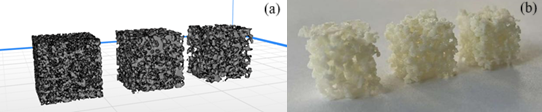
The results indicate that the composition of the PLA-HAP filament significantly influences the 3D printing process, layer adhesion, and structural integrity. Furthermore, the mechanical properties of the printed scaffolds directly correlate with the concentration of HAP within the filament.