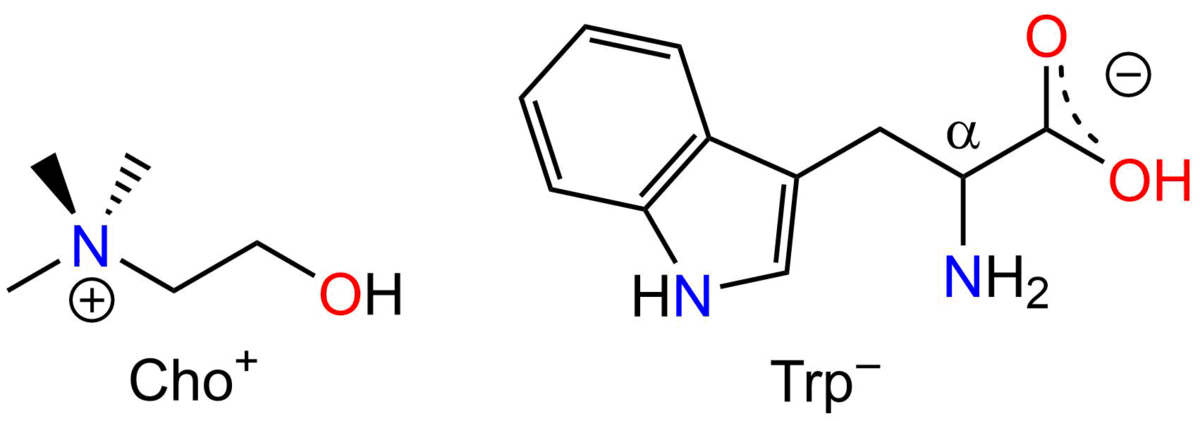
Ionic liquids (ILs) are normally defined as compounds completely composed of ions with melting point below 100 . Generally low melting point is due to one of the ions being an organic molecule whose steric hindrance interferes with the formation of crystal lattice. ILs have a wide range of applications in a variety of fields including but not limited to organic chemistry, materials science and chemical engineering [1]. One of their most attention garnering properties is the capability of increasing the solubility of organic compounds in water. In this research we are studying the change of NMR chemical shift of the choline tryptophanate ([Cho][Trp], Fig. 1) ionic liquid depending on composition of choline tryptophanate and water mixtures.
Two systems were modelled using molecular dynamics (MD) simulations: single ionic pair of [Cho][Trp] dissolved in 4000 molecules of water and 200 ionic pairs dissolved in 1800 molecules of water. Cho\(^+\) and Trp\(^-\) structure were initially optimized and RESP charges were calculated using Gaussian 16. General Amber Force Field (GAFF) and TIP4P-Ew model was implemented for ionic species and water respectively. MD simulations were performed in two stages: 1) NPT simulations with decreasing temperature from 400 K to 298 K in order to achieve thermodynamic equilibrium faster and 2) NVT 20 ns equilibration and 20 ns production runs. Radial distribution functions (RDFs) were calculated for choline N and O atoms, tryptophanate O, N\(\alpha\) and mass center of aromatic system and water O atom. Analysis of water clusterization was conducted on both systems. In the case of 1:4000 system distances between the two ions were also analysed in MD trajectory. Finally, QM/MM calculations were performed to obtain NMR shielding constants for Cho\(^+\), Trp\(^-\) and water protons in both systems in order to compare with experimental data and validate MD results.
Analysis of distances between ions in the 1:4000 system MD simulation has concluded that the ions were completely solvated for more than 99% of simulation time and did not form an ionic pair. Furthermore, coordination numbers calculated from the RDFs showed that water is the most likely surrounding molecule for Cho\(^+\), Trp\(^-\) and other water molecules. Aromatic-aromatic coordination between Trp\(^-\) ions is also prevalent in 200:1800 system. The results from water distribution analysis showed that in 200:1800 system water is most likely to belong to clusters of sizes close to 1800 molecules which has led us to believe that the majority of water contained within the system exists as part of a net like structure permeating the whole system. Overall gathered data suggest that various kinds of interactions, including hydrogen bonds and pi stacking, could be very impactful for NMR chemical shifts.