
The molecular recognition utilizing well-defined molecular constructs is the key subject of supramolecular chemistry. Metal coordination or hydrogen bonds (H-bonds) are usually employed in formation of molecular capsules that are well suited to observe the complexation phenomena and inquire into the nature of non-covalent interactions [1]. Highly flexible building blocks despite their simpler synthesis are rarely used, compared to rigid, preorganized scaffolds, due to absence of entropic penalty reduction when forming molecular aggregates. Modulation of the host-guest chemistry by extending beyond simple covalent adjustment of the cavity size represents a highly sought-after strategy to construct dynamic supramolecular receptors that are reminiscent of enzymes [2]. In nature, induced fit, conformational selection and allosteric control, operating by conformational changes of the host in response to stimuli present, are the principles governing the substrate binding and activation In our report, we present a redox control approach of a simple molecular capsule from tripodal monomer, containing three ureidopyrimidinone (UPy) 4H-bonding units, trimesic acid core and linkers with disulfide moiety (Fig. 1). We have shown that such monomers are capable of forming well-defined dimeric capsules. Furthermore, these capsules are capable of disruption by applying redox conditions that dissociate disulfide links. 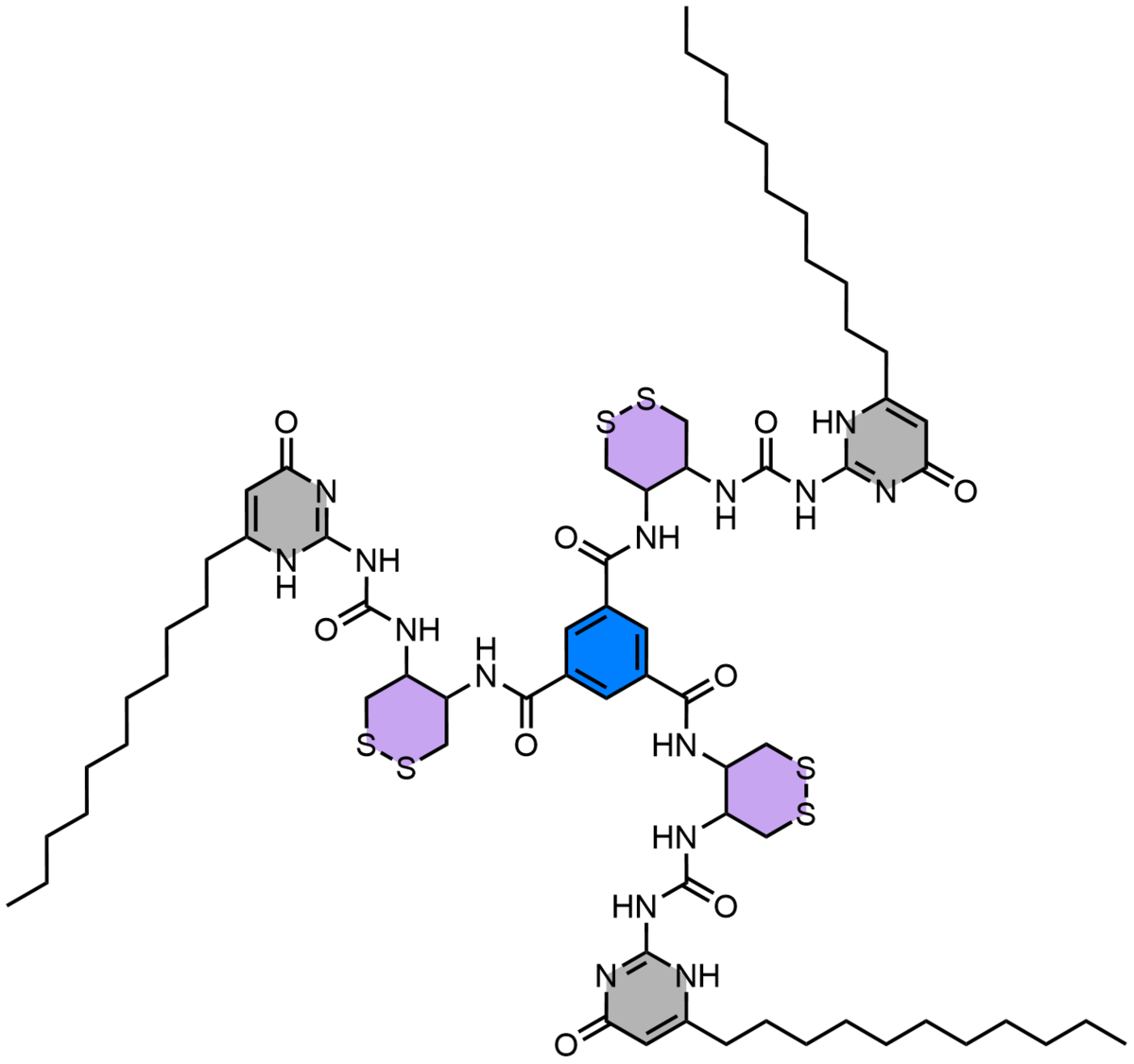
SYNTHESIS OF REDOX-ACTIVE SUPRAMOLECULAR CAPSULE
Gabija Sergejevaitė1, Domantas Valčeckas1, Edvinas Orentas1
1 Department of Organic Chemistry, Vilnius University, Naugarduko 24, LT-03225, Vilnius, Lithuania
Fig. 1. Chemical structure of the supramolecular monomer
[1] A. Morgan Conn and J. Rebek, Self-assembling Capsules. Chem. Rev., 97, 1647-1668 (1997).
[2] Jozeliunaite et al. Fullerene Complexation in Hydrogen-Bonded Porphyrin Cavitands via Induced-Fit: Cooperative Action of Tautomerization and C-H···π Interactions., J. Am. Chem. Soc., 145 (1), 455-464, (2023).