Ionic liquids (ILs) have been known as “green” and biocompatible solvents for quite some time and some of their possible biological uses include making them permeate more easily through membranes, changing catalytic activity of enzymes, as well as stabilizing or destabilizing various proteins [1]. The nature of the interactions between ILs and proteins varies and is difficult to evaluate. Therefore, smaller peptides with amino acid sequences common in proteins are often used as model systems to discover how different ILs interact with these peptides and change their structure in aqueous solution. Nuclear magnetic resonance (NMR) spectroscopy is the method best suited for identifying both intermolecular interactions and intramolecular structural changes, since the chemical shifts of atoms, particularly hydrogen, are highly sensitive to changes in the local environment of the central molecule.
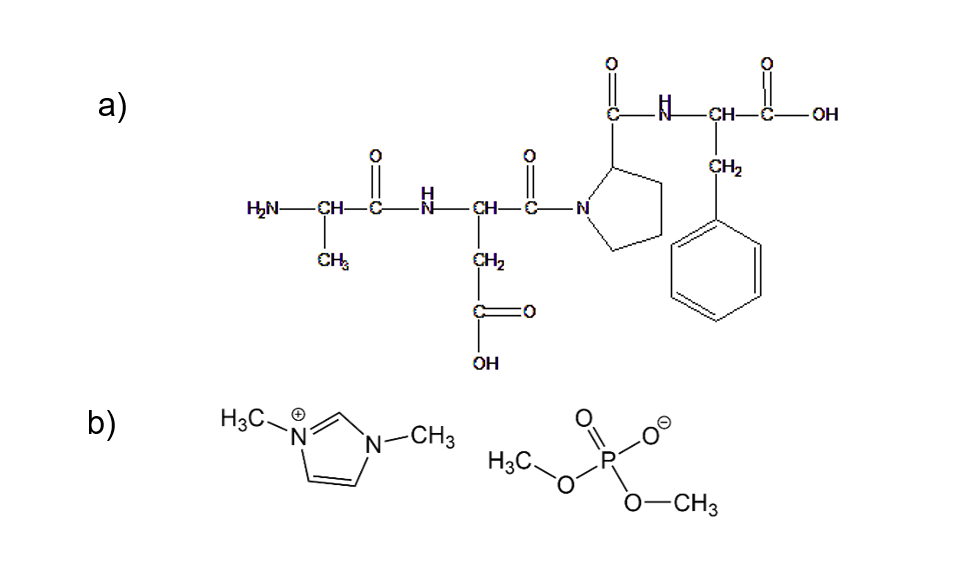
Fig. 1. 1. Structural formulas of a) peptide Ala-Asp-Pro-Phe, b) 1,3-dimethylimidazolium dimethyl phosphate.
In this work, an Ala-Asp-Pro-Phe tetrapeptide was investigated using molecular dynamics (MD) simulations and quantum mechanics/molecular mechanics (QM/MM) calculations under both aqueous conditions and in an IL/water mixture. The chosen ionic liquid (IL) was constituted of the imidazolium-based cation 1,3-dimethylimidazolium and the common IL anion dimethyl phosphate [Mmim][DMP]. Theoretical chemical shift differences of the peptide’s hydrogen atoms were compared with experimental results [2], enabling us to evaluate the various interactions present in peptide/IL/water systems. Meanwhile, trajectories from the MD simulations revealed structural changes in the peptide itself, as well as differences in its immediate surroundings. This study was supported by the Research Council of Lithuania, grant no. S-MIP-22-74. Computations were performed on resources provided by the High-Performance Computing Center “HPC Saulėtekis” at Vilnius University, Lithuania.
[1] Gomes, J. M., Silva, S. S. & Reis, R. L. Biocompatible ionic liquids: fundamental behaviours and applications. Chemical Society Reviews 48, 4317–4335 (2019)
[2] Richardt, A., Mrestani-Klaus, C. & Bordusa, F. Impact of ionic liquids on the structure of peptides proved by HR-MAS NMR spectroscopy. Journal of Molecular Liquids 192, 9–18 (2014).